SRINAGAR — J&K and Ladakh Union Territories were mildly jolted on Friday after two separate earthquakes hit the former’s Baramulla district and the latter’s Leh district, showed the data on the National Centre for Seismology (NCS) on its website.

As per the news agency CNS, the figures on the NCS showed that a tremor of magnitude 4.1 hit the Baramulla area at around 12:26:24 IST, having a depth of 10 km.

Later, at around 02:02:29 IST, another earthquake of magnitude 3.6 jolted the Ladakh’s Leh district as per the NCS, with a depth of tremor measured as 20 km.

However, there were no reports of any damage to the property or casualty due to the earthquakes.

This post first appeared on The Kashmir Pulse

SRINAGAR — A magnitude 6 earthquake shook parts of Jammu and Kashmir on Thursday afternoon.

As per initial reports, an earthquake of magnitude 6 on Richter Scale was felt across Jammu and Kashmir.

The epicenter of the earthquake is believed to be the Hindu Kush region in Afghanistan.

There was no loss of life or damage to any property, when this report was being drafted.

This post first appeared on The Kashmir Pulse

SRINAGAR — In the wake of recent seismic activities in the Jammu and Kashmir region, Kashmir Weather, an independent weather forecaster, provided insights to clarify misconceptions surrounding the earthquakes. Shedding light on several key aspects, the forecaster aimed to offer a comprehensive understanding of the ongoing seismic events.

Addressing concerns about the nature of these tremors, Kashmir Weather emphasized that the earthquakes in the region may not necessarily be foreshocks. Citing the historical seismic patterns in Jammu and Kashmir, the forecaster stated that the area predominantly experiences aftershocks rather than foreshocks. Therefore, considering the seismic history, the likelihood of a larger earthquake occurring remains low.

Kashmir Weather stated that it is essential to discern between foreshocks and aftershocks in this context. "Jammu and Kashmir's seismic history leans more towards aftershocks than foreshocks."

The forecaster highlighted the recurrence of frequent seismic activities in the region, noting that past earthquake events have been followed by numerous aftershocks, sometimes numbering in the hundreds or thousands. This recurrence pattern serves as a backdrop to the current series of earthquakes.

All recent seismic events have been localized near the same geographical area, leading Kashmir Weather to assert that these earthquakes are likely aftershocks stemming from the initial earthquake that occurred earlier.

As many as seven earthquakes were recorded as Monday's seismic unrest continued with sixth earthquake, registering a magnitude of 3.1 at 9:13 pm. This tremor, centered at 33.32°N, 76.72°E in Kishtwar, struck at a depth of 10 kilometres.

Shortly after, another earthquake rattled the region with a magnitude of 3.4 at 9:36 pm. This seismic event, also centered near Kishtwar at 33.38°N, 76.62°E, occurred at a depth of 10 kilometres.

The seismic activity extended into Tuesday, with three more earthquakes further adding to the count. An earthquake of magnitude 3.0 tremor, struck at 3:57 am at a depth of 5 kilometres, located at 33.37°N, 76.68°E in Kargil.

Subsequently, the second earthquake, measuring 3.4 in magnitude, occurred at 10:31 am at 33.33°N, 76.85°E in Kargil, reaching a depth of 10 kilometres.

Continuing the seismic surge, the third earthquake, with a magnitude of 2.9, was recorded at 11:18 am at 33.46°N, 76.43°E in Kishtwar, with a depth of 10 kilometres.

Regarding concerns about the possibility of more earthquakes, Kashmir Weather offered reassurance, stating that it is probable for the intensity and frequency of these seismic activities to diminish in the ensuing days.

"It is likely the intensity and frequency of these earthquakes will decrease in the coming days. As far as the present trend is concerned, intensity is decreasing, and earthquakes in the location may stop soon," assured the forecaster.

With a focus on providing accurate information and dispelling misconceptions, Kashmir Weather aimed to offer clarity amid the seismic events occurring in Jammu and Kashmir.

This post first appeared on The Kashmir Pulse

SRINAGAR — The region of Ladakh and Jammu & Kashmir experienced a flurry of seismic activity on Monday afternoon, with a succession of earthquakes hitting various areas, causing widespread concern and multiple aftershocks across the region.

The first earthquake, measuring 5.7 on the Richter scale, originated in Kargil, Ladakh, at a depth of 10 kilometres. Recorded at 3:48 pm, this tremor sent shockwaves throughout the area, prompting immediate alerts. The epicenter's coordinates were registered at 76.74°E, 33.15°N, according to data from Kashmir Weather, sourced via GFZ.

Shortly after, another seismic event of magnitude 5.1 jolted Kishtwar, Jammu and Kashmir, at 4:01 pm, with its epicenter at 76.7188°E, 33.1832°N and a depth of 16 kilometres. The impact of this quake was felt across the region.

Subsequently, at the same time, a third earthquake of 3.8 magnitude rocked Jammu & Kashmir and Ladakh, with coordinates at 33.34°N, 76.78°E. The depth was recorded at 10 kilometres, as reported by the National Center for Seismology (NCS).

Following these tremors, a 3.6 magnitude earthquake struck Kishtwar again at 4:18 pm, centered at 33.37°N, 76.57°E, at a depth of 10 kilometres, according to NCS data.

Continuing the series of seismic activity, a fifth earthquake measuring 3.4 on the Richter scale affected Jammu & Kashmir and Ladakh at 4:44 pm. The coordinates for this event were noted at 33.36°N, 76.72°E, with a depth of 10 kilometres.

These successive earthquakes have raised concerns about the safety and stability of the region. As aftershocks continue, the toll of earthquakes has now reached five, prompting heightened vigilance across the affected areas.

This post first appeared on The Kashmir Pulse

SRINAGAR — A moderate earthquake rattled the picturesque Kashmir Valley on Sunday morning, causing panic among residents and triggering concerns about potential damage. The tremor struck at approximately 11:25 AM local time, jolting the region with a magnitude of 4.9 on the Richter scale, according to Kashmir Weather.

The earthquake's epicenter was located near Afghanistan-Tajikistan border region (71.17°E  36.64°N) with a depth of 220 km.

Reports from various districts across the valley indicated that people rushed out of their homes and buildings in fear, seeking open spaces for safety. Tremors were felt in Srinagar, the capital city of Jammu and Kashmir, as well as in surrounding areas.

So far, there have been no reports of casualties or major damages, but officials are closely monitoring the situation.

Social media platforms are flooded with posts shared by residents, speaking of the moments of panic and the swaying of furniture and objects in their homes.

Experts warn that while this earthquake was of moderate magnitude, it serves as a reminder of the seismic vulnerability of the region. Kashmir Valley lies in a seismically active zone and has experienced significant earthquakes in the past.

As the news of the earthquake spread, concerned relatives and friends reached out to their loved ones in the affected areas, seeking reassurance of their well-being.

The seismic activity has prompted renewed discussions on earthquake preparedness and the need for enhanced infrastructure to mitigate the potential impact of future tremors.

This post first appeared on The Kashmir Pulse

SRINAGAR — An earthquake measuring 6.6 on the Richter scale jolted Jammu and Kashmir on Tuesday. As per the initial reports, the temblor struck at 10:27 PM and the epicentre was in the Afghanistan-Tajikistan border region.

The quake occurred 198 km inside the earth's crust and its coordinates were latitude 36.52 degrees north and longitude 70.97 degrees east.

No casualty or damage to property were reported from anywhere so far. However, the earthquake triggering panic among the people who rushed outside their homes and called their loved ones to enquire about their wellbeing.

Pertinently, the Kashmir valley is located in an earthquake prone region.

This post first appeared on The Kashmir Pulse

ANKARA (TURKEY) — Thinly-stretched rescue teams on Wednesday continued searching for survivors buried in the rubble of thousands of buildings destroyed in Turkey and Syria by catastrophic earthquakes and aftershocks that killed over 11,000.

Amid calls for the Turkish government to send more help to the disaster zone, Turkish President Recep Tayyip Erdogan visited a "tent city" in Kahramanmaras, where people forced from their homes are living. He conceded shortfalls early in Turkey's disaster response but vowed that no one would "be left in the streets."

Turkey now has tens of thousands of aid personnel in the quake zone, and search teams from more than two dozen countries have joined them. But with the devastation so widespread, many are still waiting for help, and hope of rescuing survivors is fading.

Experts said the survival window for those trapped under the rubble of collapsed buildings or otherwise unable to access water, food, protection from the elements or medical attention was closing rapidly. At the same time, they said it was too soon to abandon hope for more rescues.

"The first 72 hours are considered to be critical as the condition of people trapped and injured can deteriorate quickly and become fatal if they are not rescued and given medical attention in time," Steven Godby, a natural hazards expert at Nottingham Trent University in England, said.

Turkey's disaster management agency said on Wednesday that the recovered bodies of people who died in the earthquakes but cannot be identified would be buried within five days even if they remained unnamed.

The agency, known as AFAD, said unidentified victims would be buried following DNA tests, fingerprinting and after being photographed for future identification. The move is in line with Islamic funeral rites, which require burial to take place as quickly as possible after a person's death.

In the Turkish city of Malatya, bodies were placed side by side on the ground, covered in blankets, while rescuers waited for funeral vehicles to pick them up, according to former journalist Ozel Pikal, who saw eight bodies pulled from the ruins of a building.

Pikal took part in the rescue efforts and said he believes at least some of the victims may have frozen to death as temperatures dipped to 21 degrees Fahrenheit. "Today isn't a pleasant day, because as of today, there is no hope left in Malatya," Pikal told The Associated Press by telephone. "No one is coming out alive from the rubble."

Pikal said a hotel building collapsed in the city and more than 100 people may be trapped.

He said there was a shortage of rescuers in the area he was in, and the cold, road closures and damage in the region have also impeded mobility and access. "Our hands cannot pick up anything because of the cold," said Pikal. "Work machines are needed."

The scale of suffering was also staggering in Syria, a region already beset by more than a decade of civil war that has displaced millions within the country, prompting many to seek refuge in Turkey. With thousands of buildings toppled there, it wasn't clear how many people might still be trapped underneath the rubble.

Aid efforts in Syria have been hampered by the ongoing war and the isolation of the rebel-held region along the border, which is surrounded by Russia-backed government forces. Syria itself is an international pariah and is under Western sanctions linked to the war.

The United Nations said it was "exploring all avenues" to get supplies to the rebel-held northwest of the country, and on Wednesday, the Syrian Observatory of Human Rights said Egypt had sent a medical and rescue team.

The European Union said Wednesday that Syria had asked for humanitarian assistance to support the victims. An EU representative insisted the bloc's sanctions against the Syrian government had no impact on its potential to help.

Syrian Prime Minister Hussein Arnous visited neighborhoods in the northern city of Aleppo on Wednesday, where buildings collapsed. "Our priority now is to rescue the people who are still under the rubble," he said.

In rebel-held parts of northwest Syria, rescuers pulled a man, a woman and four children from the rubble in the towns of Salqeen, Harem and Jinderis, according to the White Helmets group.

On Monday afternoon in the northwestern Syrian town of Jinderis, residents found a crying newborn still connected by the umbilical cord to her deceased mother. The baby was the only member of her family to survive when her family home collapsed, her father's cousin told the AFP news agency. The baby's father, mother, aunt and siblings perished.

Polish rescuers working in Turkey said they had pulled a number of people alive from the rubble so far, including parents with two children and a 13-year-old girl from the ruins in the city of Besni. They said low temperatures were working against them, though two firefighters told Polish TVN24 that the fact that people were caught in bed under warm covers by the pre-dawn quake could help.

But David Alexander, a professor of emergency planning and management at University College London, said data from past earthquakes suggested the likelihood of survival was now slim, particularly for individuals who suffered serious injuries or significant blood loss. "Statistically, today is the day when we're going to stop finding people," he said. "That doesn't mean we should stop searching."

Alexander cautioned that the final death toll may not be known for weeks because of the sheer amount of rubble that needs to be sifted.

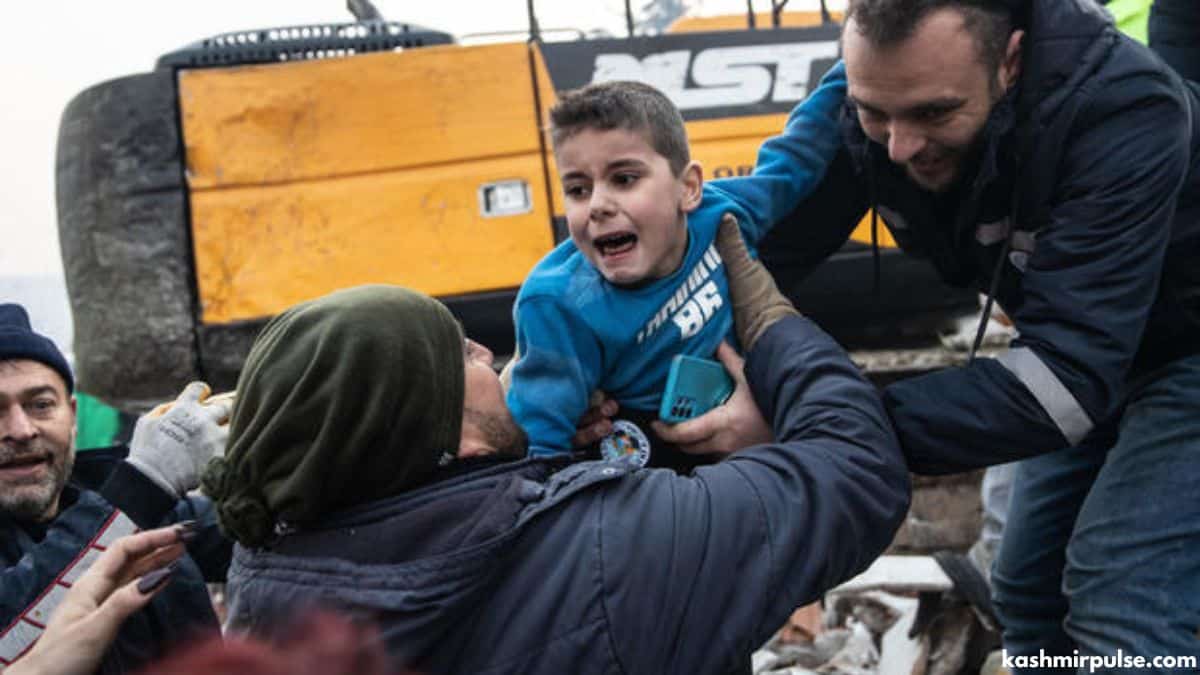
Stories of rescues did continue to provide hope, however. Nearly two days after the quakes, rescuers pulled a 3-year-old boy, Arif Kaan, from beneath the rubble of a collapsed apartment building in Kahramanmaras, which isn't far from the epicenter.

With the boy's lower body trapped under slabs of concrete and twisted rebar, emergency crews spread a blanket over his torso to protect him from below-freezing temperatures as they carefully cut the debris away from him, mindful of the possibility of triggering another collapse.

The boy's father, Ertugrul Kisi, who himself had been rescued earlier, sobbed as his son was pulled free and loaded into an ambulance. "For now, the name of hope in Kahramanmaras is Arif Kaan," a Turkish television reporter proclaimed as the dramatic rescue was broadcast to the country.

Many survivors in Turkey have had to sleep in cars, outside or in government shelters.

"We don't have a tent, we don't have a heating stove, we don't have anything. Our children are in bad shape. We are all getting wet under the rain and our kids are out in the cold," Aysan Kurt, 27, told The Associate Press. "We did not die from hunger or the earthquake, but we will die freezing from the cold."

As many as 23 million people could be affected in the quake-hit region, according to Adelheid Marschang, a senior emergencies officer with the World Health Organization, who called it a "crisis on top of multiple crises."

Erdogan, on his tour of quake-hit areas, acknowledged that there were problems early on in the response but said it had improved. He said his government would distribute the equivalent of $532 to affected families.

The disaster comes at a sensitive time for Erdogan, who faces presidential and parliamentary elections in May amid an economic downturn and high inflation. Perceptions that his government mismanaged the crisis could severely hurt his standings.

The region sits on top of major fault lines and is frequently shaken by earthquakes. Some 18,000 were killed in similarly powerful earthquakes that hit northwest Turkey in 1999.

This post first appeared on The Kashmir Pulse

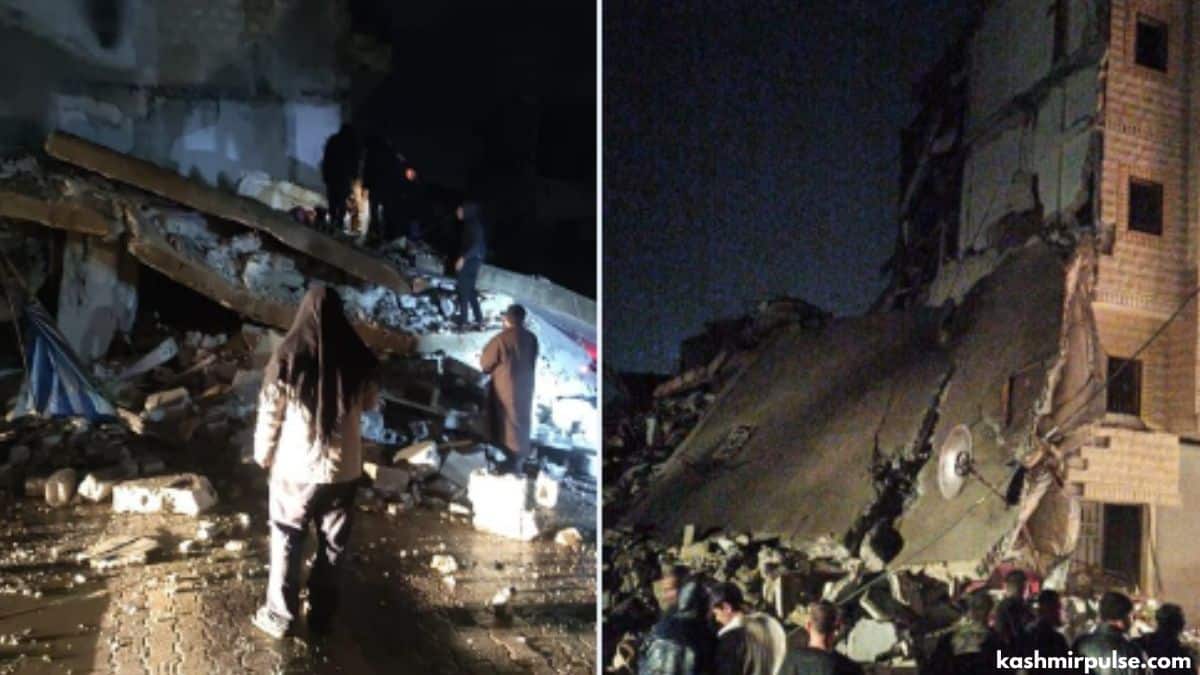
ANKARA (TURKEY) — A major earthquake of magnitude 7.8 struck central Turkey and north-west Syria early on Monday morning, killing at least 1,200 people and injuring thousands as buildings collapsed across the region, triggering searches for survivors in the rubble.

Turkey’s president, Recep Tayyip ErdoÄŸan, said 912 people had been killed in Turkey, with 5,383 wounded. He said authorities were unable to predict how high the toll may rise as search and rescue operations continued, Reuters report. He said 45 countries had so far offered assistance.

Syria’s state news agency reported more than 320 dead in the country, with over 1,000 wounded. The White Helmets rescue service reported that 147 people had died and more than 340 were injured in Syria in areas where it operates, which are unlikely to have been included in the official state figures.

The quake hit at 4:17 AM local time (0117 GMT) and was felt in Syria, Lebanon, Cyprus, Greece and Israel. The quake was centered about 32 km (20 miles) from Gaziantep, a major city and provincial capital in the country’s southeast, and about 26 km (16 miles) from the town of Nurdağı.

It was 17.7 km (11 miles) deep, according to the US Geological Survey. A strong 6.7 temblor rumbled about 10 minutes later.

ErdoÄŸan spoke by telephone with the governors of eight affected provinces to gather information on the situation and rescue efforts, his office said in a statement.

The Turkish interior minister, Süleyman Soylu, said 10 cities had been affected by the quake. Speaking to reporters on Monday, the official said the cities of Gaziantep, Kahramanmaraş, Hatay, Osmaniye, Adıyaman, Malatya, Şanlıurfa, Adana, Diyarbakır and Kilis had all suffered damage.

This post first appeared on The Kashmir Pulse
SRINAGAR — An earthquake measuring 6.0 on the Richter scale jolted Jammu and Kashmir on Thursday evening.

Independent Weather Forecaster, Faizan Arif Keng informed the news agency KNO that the temblor struck at 7:55 PM and the epicenter was Hindu Kush Region, Afghanistan. The depth of the earthquake was 191 kilometers.

However, there were no reports of any loss of life or damage to the property when the report was last filed.

This post first appeared on The Kashmir Pulse

SRINAGAR — Stating that there was nothing to worry over the frequent earthquakes in Jammu and Kashmir, the experts here on Saturday said that no one can predict the timing and intensity of the earthquake.

Professor ‪Shakil Ahmad Romshoo‬, a geologist, who is currently Vice Chancellor of the Islamic University of Sciences and Technology (IUST), while talking to the news agency KNO said that there is no mechanism available to predict the position, magnitude or timing of the earthquake.

“The places where back-to-back earthquakes are being reported in the past 6-7 days have also witnessed 39 back-to-back foreshocks in the year 2013 and even one among them was measuring 6, but there was no major earthquake then after,” Romshoo said.

He further added that Jammu & Kashmir and Ladakh are very vulnerable from an earthquake point of view, but it is not possible that foreshocks will lead to a major earthquake.

However, he said that keeping in view the vulnerable area from an earthquake point of view, the people should take long-term measures like houses, schools, hospitals and other places should be made earthquake resistant for which everybody has to play a role.

Assistant Professor, Rakesh Chandra, who currently works at the Department of Earth Sciences, University of Kashmir, said that it is a fact that a lot of energy is accumulated below the Kashmir Himalayas, which is the outcome of the Kangra earthquake in 1905 and the Muzaffarabad earthquake in 2007. “The energy below Kashmir Himalayas will get released through earthquakes only, but no one can predict the timing and intensity of the earthquake."

“There are chances of energy release through an earthquake, but it can be low intensity or major also, which is a natural process, whatever it is inside, it has to come out,” he said, adding that nobody can predict when the earthquake is going to occur.

About the frequent earthquakes, he said that it is good that the energy is released without any harm to the property as well as the life. “Instead of having major earthquakes, it is better to witness low-intensity jolts for the release of energy. There is nothing to worry about earthquakes, it is a natural phenomenon. I just want to appeal to people that they should get aware of the earthquake rather than be in a panic,” he said.

This post first appeared on The Kashmir Pulse
JAMMU — Renowned geologist Prof M A Malik on Friday cautioned against the possibility of a major earthquake in Jammu and Kashmir due to its vulnerable location in the Himalayan mountains.

Prof Malik, retired Head of the Department of Geology of the University of Jammu (JU), said this in response to the recent minor tremors in J&K.

J&K witnessed 11 minor tremors during the last four days. Doda district in particular witnessed tremors ranging from 2.8 to 3.4 on the Richter scale during the past few days, which has unnerved the people.

In the Doda district, on August 24, the magnitude of the earthquake was 3.2 on the Richter scale. On August 26, Doda witnessed tremors of a magnitude of 3.4. Again, on the same day, a quake of a magnitude of 2.8 shook Doda. However, geologists refer to these minor tremors as releases of pressure by the earth.

Prof Malik said, “Himalayan belt and Asian plate are vulnerable to major earthquakes up to 7 to 8 Richter scale. We have not witnessed such an earthquake in the last 100 years. Hence, there is every possibility of a major earthquake which may shake J&K as it is a vulnerable area.”

Cautioning about the possibility of a major earthquake, he said, “In a way, small tremors are a blessing in disguise as the pressure gets released although it can also be a warning sign before big jolts.”

Prof Malik said that as J&K comes in the seismic zones of 4 to 5, there was a need to be cautious while constructing buildings, bridges, dams, and structures as per the recommended code of building construction that could resist earthquakes.

However, the recommendations to construct earthquake-resistant buildings are generally not followed except in government structures. “Unstable and loose earth close to water bodies is vulnerable and unsafe to construct any structure. So, people should avoid construction of buildings or any kind of structures there and follow building codes,” Prof Malik said.

Assistant Professor in the JU’s Geology Department, Yudhbir Singh said that the impact of the earthquake depends on things like the depth and structure on the surface of the earth and magnitude, Greater Kashmir reported.

“It is difficult to predict the exact nature, time, and place of an earthquake. The recent earthquakes are a cause of concern but there is no need to panic. These tremors often release the stress that is developed in the crust of the earth and decrease the chance of a big earthquake. As far as predicting earthquakes is concerned, scientists even in countries like Japan and US can’t predict the timing,” Singh said.

“We are vulnerable to earthquakes and should prepare for the reality which is very evident in the area at any time in the next 30 years. Everyone needs to follow proper guidelines and take a serious note on unscientific activities happening around us,” he said and added that assuming that the recent earthquakes in the Doda district are due to the construction of a large number of dams is illogical.

This post first appeared on The Kashmir Pulse

SRINAGAR — An earthquake of 3.4 magnitude hit Jammu and Kashmir’s Bandipora district on Monday morning, with no damages or casualties reported.

As per the National Centre for Seismology (NCS), the earthquake was 3.4 in magnitude and its epicenter was at a depth of 50 kilometres in north Kashmir’s Bandipora area.

The earthquake took place at 10:31:16 IST, according to the NCS.

However, there were no reports of any damage incurred as only fragile structures remain susceptible to minor tremors.

This post first appeared on The Kashmir Pulse
Powered by Blogger.