
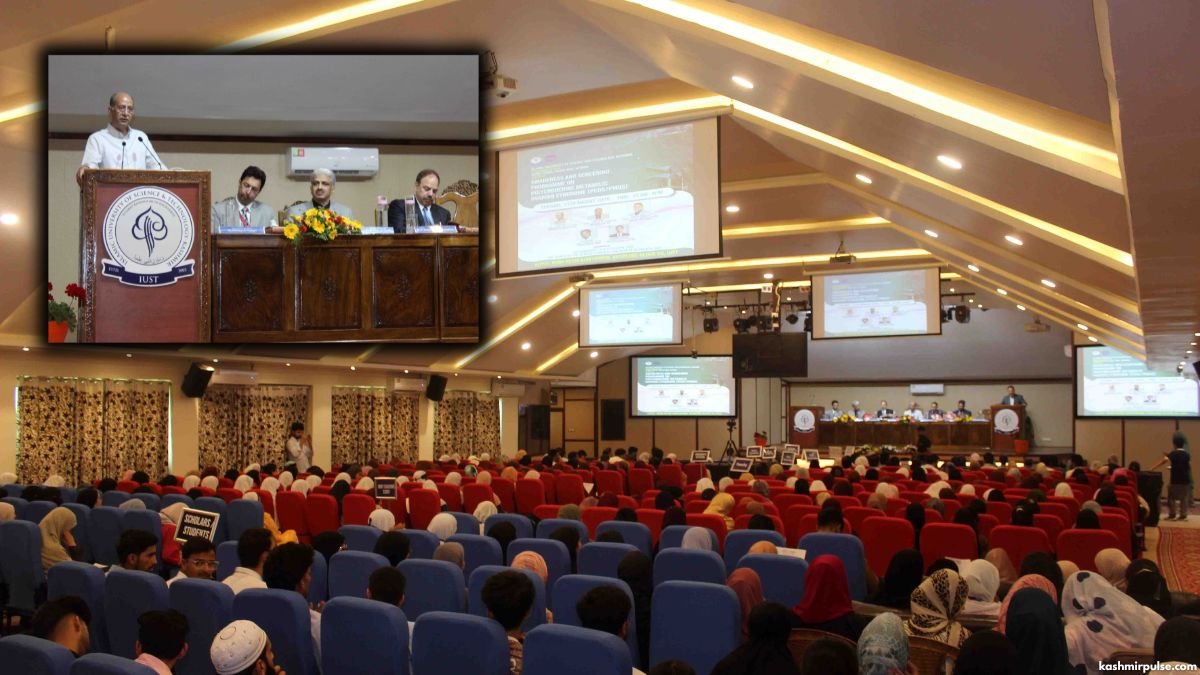
SRINAGAR — The Islamic University of Science and Technology (IUST), in collaboration with SKIMS Soura and SKIMS MCH, Bemina, organised an awareness and screening programme on Polyendocrine Metabolic Ovarian Syndrome (PCOS/PMOS) at the University's main campus.
The programme was organised by the University Health Centre in association with the Offices of the Dean of Students and Dean Outreach, IUST, with a focus on raising awareness about the condition and promoting holistic management.
Chief Guest Nasir Aslam Wani, Advisor to the Chief Minister of J&K, attended the programme. Prof. Shakil A. Romshoo, Vice Chancellor, IUST, was the Chief Patron, while Prof. Mohammad Ashraf Ganie, Director, SKIMS Soura, and Prof. Fazul ul Qadir, Principal, SKIMS MCH, Bemina, were the Guests of Honour.
Addresses by dignitaries
Wani appreciated IUST for consistently taking up issues of public concern and called for a change in how PCOS/PMOS is perceived and discussed in society. He also expressed hope that IUST would establish a medical college in the future, acknowledging its achievements in health sciences and nursing education, and expressed the aspiration that IUST would one day emerge as "Kashmir's Stanford."
Romshoo called for making health-awareness programmes a regular feature of educational institutions. Referring to the University's student clubs and expanding School of Health Sciences, including its nursing colleges and other centres, he stressed the importance of creating more platforms for health awareness and community engagement.
Delivering the keynote address, Ganie highlighted key milestones in the history of research on PCOS/PMOS and emphasised the need for a stronger research base. He noted that the terminology surrounding the condition continues to evolve and drew attention to the growing burden of metabolic diseases, particularly in low-income societies. He also said the underlying causes are not yet fully understood, observing that the condition involves metabolic disturbances that can affect men as well.
Prof. Shameem Ahmad Shah, Registrar, IUST, highlighted the significance of organising such programmes, particularly given the substantial number of female students at the University. He emphasised the need to strengthen institutional collaboration with SKIMS and expressed hope for a formal Memorandum of Understanding (MoU) between the institutions.
Dr. (Prof.) Ashfaq-ul-Hassan, Professor and Head, Anatomy, SKIMS MCH, highlighted the importance of bringing medical experts and students together for meaningful discussions. Qadir introduced the participating medical experts and expressed gratitude to the dignitaries and participants. Prof. Ejaz Rather, Associate Dean, Academic Registrar and former Head of Surgery, SKIMS, highlighted the strength of SKIMS in bringing multiple specialised departments under one roof and emphasised the need to further strengthen endocrinology-related services.
Technical session
The inaugural session was followed by a technical session by medical experts. Dr Anjum Malik, Professor of Obstetrics and Gynaecology, spoke on the role of gynaecology in the diagnosis, hormone regulation and management of PCOS. Prof. Farah Sameem, Professor of Dermatology, discussed the dermatological manifestations of PCOS and their diagnosis and management, while Dr Afiya Shafi, Professor and Head of Pathology, discussed the pathophysiological mechanisms and endocrine disruptions associated with the condition.
The programme concluded with a student perspective session with Dr Musharraf and Dr Sajjad Hamid, followed by an interactive question-and-answer session. The welcome address was delivered by Dr Monisa Qadri, Dean of Students, IUST, while Dr Zahida Rasool, Medical Officer, IUST, presented the vote of thanks. A screening and consultation session for female students and staff was also conducted.
The article first appeared on The Kashmir Pulse at https://kashmirpulse.com/education/iust-skims-hold-joint-awareness-programme-on-pcos-pmos/115224.html
Post a Comment
Refrain from posting comments that are obscene, defamatory or inflammatory, and do not indulge in personal attacks, name calling or inciting hatred against any community. Let's work together to keep the conversation civil.