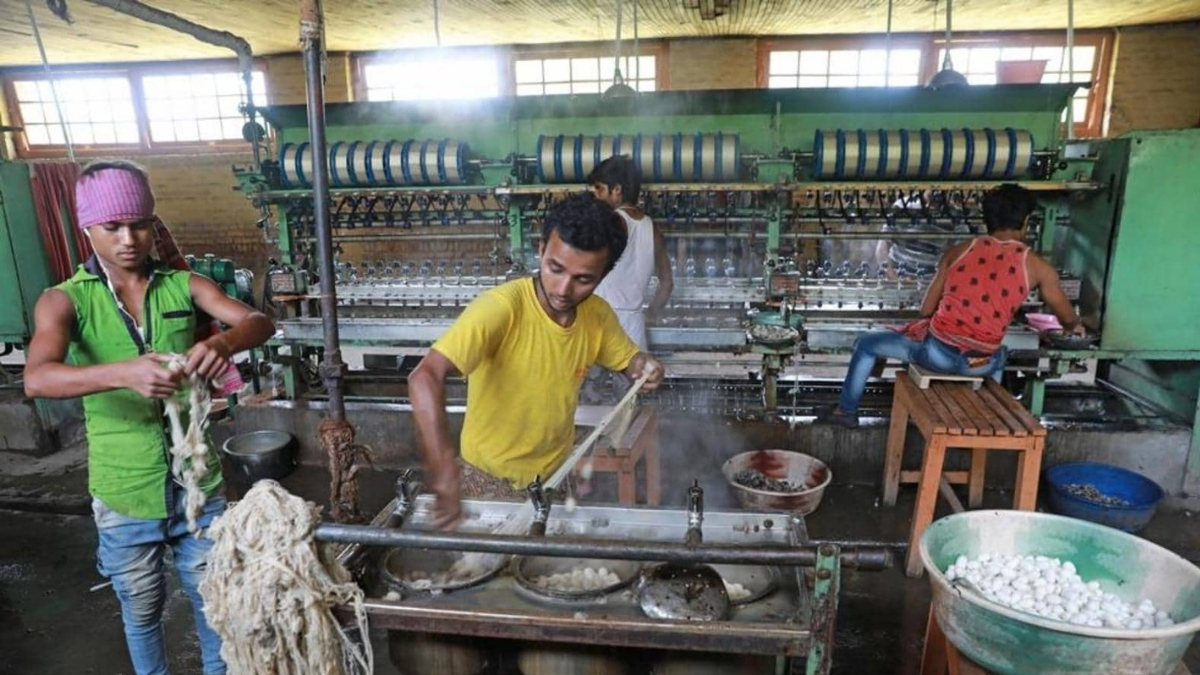
SRINAGAR — The World Bank funding has played a crucial role in the revival of Kashmir's eight-decades-old silk factory, as the introduction of new technology and high-tech looms funded by the bank has increased eightfold in the past years, an official said.

The silk fabric production at Srinagar's government-run 86-year-old Rajbagh silk factory has increased by almost three times, with the involvement of better machines and equipment, Syed Zameer, the manager of the silk factory, informed the news agency KNO.

"The Rajbagh silk factory was established in the year 1937, and at that time, we had different machines and looms available here," he said.

Zameer said after the 2014 flood, the machines and equipment here became non-functional. Under the Jhelum Tawi Flood Recovery Project (JTFRP), financed by the World Bank, efforts were made not only to restore heritage buildings but also to support the livelihoods of those affected, including the revitalization of the silk industry, he said.

The project, the manager said, aimed to maintain the livelihood of people affected by the floods and also restore Jammu and Kashmir’s heritage buildings. "The funding also helped us to increase our production, and presently we can manufacture more products than in the past," he said.

"We can manufacture 1.5 lakh metres of silk in a single shift and 4.5 lakh metres if we work in three shifts,” he said, adding that before the JTFRP project, they had only seven to eight varieties of silk available, but currently, the factory manufactures thirty varieties of silk.

"We have also increased and enhanced the quality by almost three times," he said and added that the sales have increased by about five times, and now, they have tie-ups with many parties from outside Jammu & Kashmir who are purchasing the silk-made products.

The equipment including TFOs, winding machines, TLC-based looms and warping machines helped us further increase our production, he added.

The modernization and the upgradation of the government silk weaving factory, Rajbagh, was done in the year 2021 and was inaugurated by Lieutenant Governor Manoj Sinha.

This post first appeared on The Kashmir Pulse

SRINAGAR — In what could be seen as a major achievement by Manoj Sinha-led administration on the development front, the World Bank has said that its Rs 1500 crore project in J&K has largely achieved its objective and, in some cases, surpassed the agreed targets.

The Rs 1500 crore project funded by the World Bank was a non-starter during the PDP-BJP rule. It was bogged down by multiple hiccups before Syed Abid Rashid Shah was brought in as its head.

“The project development objective is to support recovery, increase disaster resilience in project areas, and increase the capacity of the project implementing entity to respond promptly and effectively to an eligible crisis or emergency. JTFRP was focused on recovery and mitigating risks linked to floods in Kashmir. The project has largely achieved this and, in some cases, has surpassed the agreed targets,” reads the latest status report of the project, as per the news agency KNO.

The report was released by the World Bank on June 29, 2023. According to the report, 78.4 per cent of contracts under the WB-funded project has been completed.

“Of the 213 contracts, 167 (78.4%), are complete, and another 40 are expected to be completed by the project closing date. Currently, the project has disbursed about 67%,” the report further states.

The key achievements under the project include 52 school buildings, four higher education buildings, one fire station, 80 kilometres of road stretches, four bridges, 75 kilometres of drainage network and 33 storm-water drainage pumping stations, critical medical equipment and supplies to 36 hospitals, augmenting 108-Helpline with 68 critical care ambulances, commissioning of 30 oxygen generation plants covering all districts of the state apart from strengthening handicraft, handloom, silk and wool sector.

Before Abid was appointed as chief executive officer of the project in 2020, it saw 13 bosses, which includes 10 IAS officers, in less than five years. Abid played a key role in accelerating the pace of works approved under the project.

In the past, the WB frequently snubbed the J&K Government over the slow pace in the implementation of the project and even there were fears of losing funds under it.

This post first appeared on The Kashmir Pulse


SRINAGAR — Noting the remarkable progress made over the last 2.5 years, the World Bank has extended the deadline for completion of its Rs 1500 crore project in Jammu & Kashmir by one more year, but made it clear to the Central Government and J&K authorities that any works not completed by December 31, 2023, would need to be completed with the government’s own resources.


In a letter to the Union Finance Ministry and J&K administration, the World Bank has accepted the Union Finance Ministry’s request to extend the deadline of the project to December 31, 2023.


“We also refer to the letter from the Department of Economic Affairs, Ministry of Finance F.No. 05/06/2014-FB.VIII/V dated December 19, 2022, requesting the Association to extend the Closing Date of the Credit by 12 months. We are pleased to inform you that the Association concurs with the request and has established December 31, 2023, as the later date for purposes of Section IV.B.2 of Schedule 2 to the Financing Agreement,” reads the letter written by WB’s Hideki Mori, Acting Country Director, India to Rajat Kumar Mishra, Additional Secretary (MBC), Department of Economic Affairs Ministry of Finance and Arun Kumar Mehta, Chief Secretary, J&K.


But the WB has made it clear to them that any works of the project not completed by the closing date of December 31, 2023, including for L.D. Hospital Srinagar, would need to be completed with the government’s own resources.


After the 2014 floods, the Jehlum-Tawi Flood Recovery Project (JTFRP) was approved by the World Bank in June 2015 for the reconstruction of the damaged public sector infrastructure and for strengthening J&K’s disaster management mechanism.


The closing date of the Rs 1500 crore project was June 30, 2020, which has been extended to December 31, 2023. The project has faced multiple challenges, including COVID-19, which led to substantial implementation delays.


According to the World Bank, the project has shown remarkable progress over the last 2.5 years in improving the pace of public infrastructure construction, completing livelihood support activities, implementing CERC component activities to boost healthcare services for COVID response, and augmenting disaster preparedness capabilities.


One of the notable contributions of the project has been the installation and commissioning of 30 oxygen generation plants in rural areas of J&K which include areas like Gurez, Tangdar and Bani Basohli. The project has committed 100% of the credit with signed contracts including the cost variations and funds earmarked for implementation support.


Out of 213 contract packages under the project, 159 (74 percent) have been completed till December 15, 2022. These include the completion of 41 schools and higher education buildings, 10 road packages, one bridge, silk and wool factories and a showroom with new machinery; procurement and deployment of mobile pumps, search and rescue equipment; and training and technical support to handloom and handicrafts sector and artisans; and several technical studies and assessments.


This post first appeared on The Kashmir Pulse
Powered by Blogger.