SRINAGAR — Jammu and Kashmir encountered an unprecedentedly dry and warm January, marking the driest and warmest month in 43 years, as revealed by data from the Meteorological Centre Srinagar.

In Srinagar city, a mere 3.0 mm of precipitation was recorded, rendering it the second driest January in four decades, a stark contrast to the lowest measurement of 1.2 mm in January 2018.

The mean maximum temperature in Srinagar stood at 11.9 degrees Celsius, while figures for Gulmarg and Banihal were recorded at 5.7 degrees Celsius and 16.9 degrees Celsius, respectively.

Jammu City, too, bore witness to historically low mean maximum temperatures, an occurrence unseen in over 40 years.

The Meteorological Department characterized January 2024 as exceptionally dry and warm, with Jammu station registering a mean maximum temperature of 13.4 degrees Celsius, a low not seen since 1983.

Meanwhile, mean minimum temperatures for January were documented at -3.2 degrees Celsius, 5.5 degrees Celsius, -3.9 degrees Celsius, and 0.1 degrees Celsius for Srinagar, Jammu, Gulmarg, and Banihal, respectively.

Of particular note, Gulmarg experienced one of its warmest mean minimum temperatures in 43 years, according to the provided data.

This post first appeared on The Kashmir Pulse
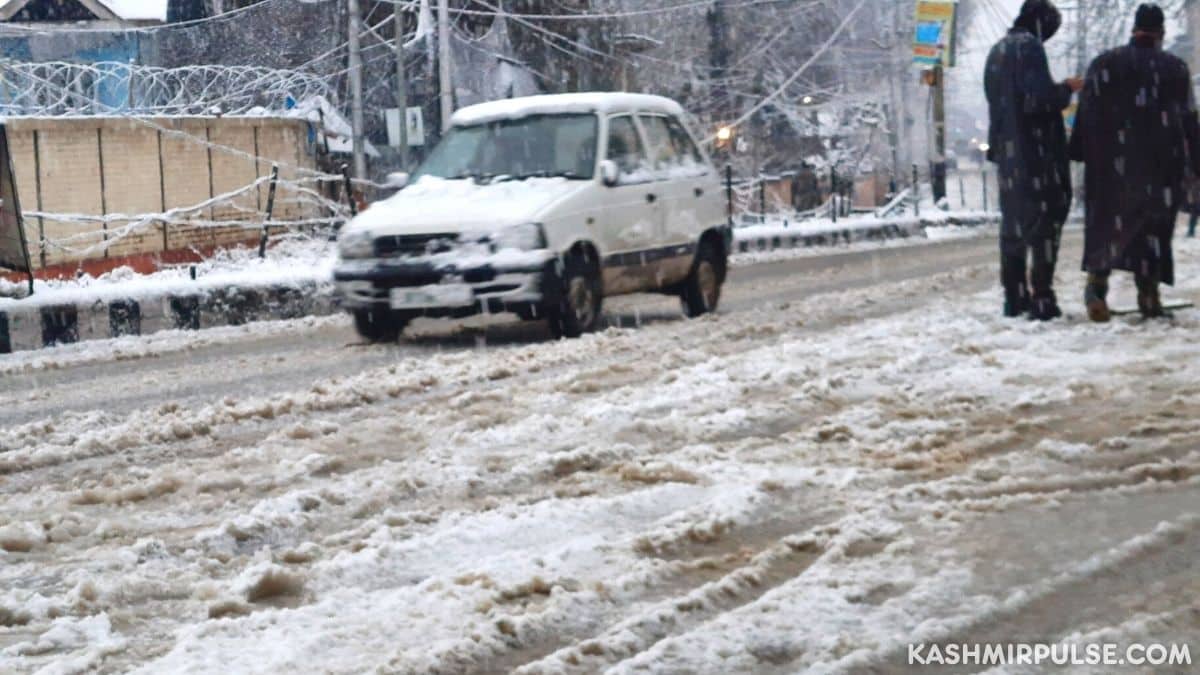
SRINAGAR — The end of the 40-day Chilai Kalaan marked the onset of the 20-day Chillai Khurd in Kashmir, bringing a wet entry with widespread snowfall that covered Srinagar and various other regions, providing much-needed relief to the valley.

Snow Blankets Region

Snowfall was observed in Srinagar, Gulmarg, Sonamarg, Pahalgam, and other central and south Kashmir areas. The snowflakes not only ended the two-month-long dry spell but also brought smiles to the faces of Srinagarites who eagerly awaited the natural white cover.

According to a local news agency, several places experienced significant snowfall in the initial two days of Chillai Khurd. Sadhna Top received over 4 ft of snowfall, Gurez received 3 ft, and other areas recorded varying amounts, creating picturesque landscapes.

Transportation Disruptions

The change in weather patterns led to the closure of the Jammu-Srinagar National Highway due to landslides in Ramban district, stranding over 200 vehicles. Sherbibi area witnessed landslides, closing the highway, the only all-weather road connecting Kashmir with the rest of the country.

Officials reported damage near Sherbibi on the Jammu-Srinagar highway, with restoration work underway. The closure affected the stranded vehicles, prompting traffic police to initiate measures for assistance.

Weather Forecast

Director of the Meteorological Department, Dr Mukhtar Ahmad, stated that generally dry weather with the possibility of very light snow is expected at isolated higher reaches. The forecast predicts light to moderate snow and rain across Jammu and Kashmir on Saturday and Sunday. However, the weather is expected to turn dry from February 5 to 12.

The local Meteorological department issued an advisory, urging travellers to plan accordingly due to intermittent moderate to heavy snow leading to temporary road closures in higher reaches and important passes. They advised following administration and traffic police advisories for a safe journey.

Closure of Jammu-Srinagar Highway

Over 200 vehicles remain stranded on different points of the 270-km Jammu-Srinagar highway, highlighting the challenges posed by the weather conditions. The closure emphasizes the need for caution and preparedness among travellers during this winter season in Kashmir.

This post first appeared on The Kashmir Pulse

SRINAGAR — In a first of its kind, Srinagar, the summer capital of Jammu and Kashmir and other parts of the Valley witnessed the record-breaking driest Chillai Kalan this year.

As per the details shared by the Meteorological department, this year's prolonged dry spell has surpassed the previous records at all the stations across Kashmir.

In Srinagar, a precipitation of 1.5 mm was received from December 21, 2023 to January 30, 2024, thereby recording the driest-ever Chillai Kalan. The previous driest Chillai Kalan in Srinagar was witnessed in 2015 when 5.6 mm of precipitation was recorded.

According to the news agency KNO, Gulmarg, a famous ski-resort, has surpassed the record of 1987 when 17.7 mm of precipitation was recorded. The famous spot has recorded a precipitation of just 17.3 mm this Chillai Kalan.

Qazigund also surpassed the record of 2018 as against the then precipitation of 4.8mm, it has recorded 0.0 mm precipitation this Chillai Kalan.

Pahlagam, a famous tourist spot has witnessed the driest-ever Chillai Kalan after the gap of six years as against the precipitation of 13.9 in 2018, it has recorded a precipitation of only 2.7 mm in the last 40 days.

Kupwara also recorded a low precipitation during the 40-day harshest winter period this year as against the previous record of 15.8 mm in 2001, it has received a precipitation of just 13.8 mm.

Kokernag and Banihal have recorded 0.0 mm precipitation this Chillai Kalan, thus simultaneously breaking the previous record of 5.5 mm and 4.3 mm precipitation respectively in the year 2018.

Pertinently, the 40-day Chillai Kalan in Kashmir this year witnessed warmer days and prolonged dry spell while the experts here have sounded alert, saying that the dry spell will have repercussions in the future.

This post first appeared on The Kashmir Pulse
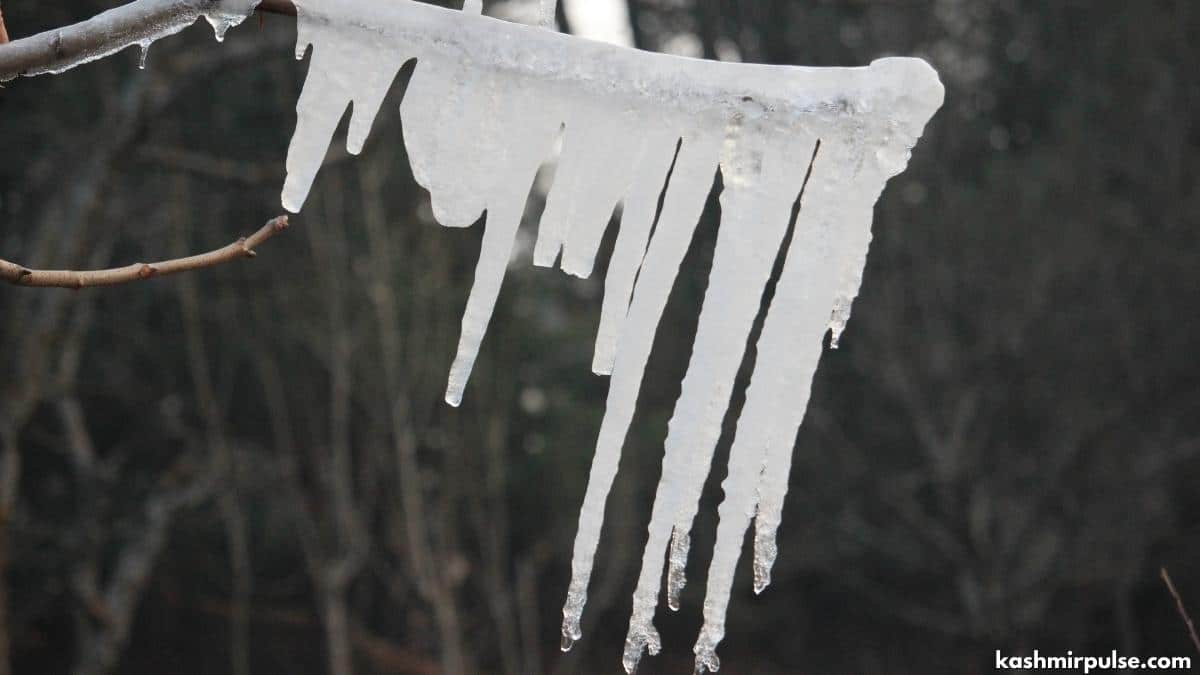
SRINAGAR — The higher reaches of the Kashmir valley witnessed a fresh bout of snowfall, while some plains experienced rainfall, setting the stage for an extended spell of wintry weather.

Meteorological Department officials have extended their forecast, predicting prevailing weather conditions to persist until February 3 in the region.

According to the officials, the latest snowfall measurements in various areas of Kashmir are a mixed bag, with Doodhpathri recording two inches, Ganderbal (Sonamarg/Zojila) recording a feet, Bandipora (Razdan Top) recording two feet, Dawar Gurez recording six inches of snowfall.

Also, Izmarg with 16 inches, Tulail with four inches, Kupwara (Sadna Top) with 18 inches, Farkin Top with 16 inches, Z-Gali with two feet and Machil with 12 inches of snowfall marked a wet wintery day.

Meteorological department officials outlined the forecast for January 29, indicating a possibility of light to moderate rain and snow at numerous locations across Jammu and Kashmir. Heavy snowfall is anticipated over isolated higher reaches of the Kashmir Division, including districts like Kupwara, Baramulla, Bandipora, Ganderbal, Shopian, Anantnag, and Kulgam, extending till late Monday afternoon.

Looking ahead to January 30-31, the forecast suggests a likelihood of light to moderate rain and snow at many places in Jammu and Kashmir, with the potential for heavy snowfall in select higher reaches within the Kashmir region.

Similarly, between February 1-2, the weather is expected to remain generally cloudy, with light rain and snow anticipated at various locations during late afternoon and evening periods. On February 3-4, there is a possibility of light to moderate rain and snow covering many places in Jammu and Kashmir.

Residents and travellers are advised to stay vigilant and plan accordingly, as the region grapples with the wintry mix and potential challenges posed by heavy snowfall in specific areas.

This post first appeared on The Kashmir Pulse
SRINAGAR — With the onset of Chillai-Kalan, the 40-day period of intense winter, the mercury has dropped significantly across the Kashmir Valley. The local meteorological department predicts dry weather conditions prevailing until the conclusion of this month.

As reported by the news agency KNO, the night temperatures across the valley have fallen several degrees below freezing, with Srinagar, the summer capital of Jammu and Kashmir, recording a low of minus 4.3 degrees Celsius.

Qazigund in south Kashmir registered a low of minus 4.0 degrees Celsius, while Pahalgam recorded a minimum temperature of 5.8 degrees Celsius.

In Gulmarg, the mercury settled at minus 3.0 degrees Celsius, while Kupwara in north Kashmir experienced a low of minus 4.0 degrees Celsius. Similarly, in Kokernag, the temperature dropped to minus 3.0 degrees Celsius.

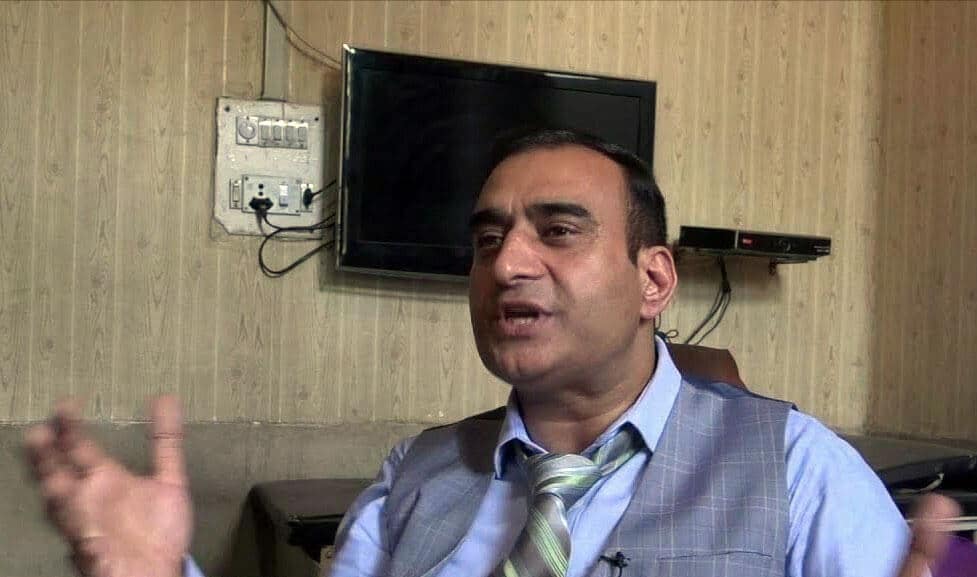
Dr. Mukhtar Ahmad, Director of the Meteorological Department (MeT), informed that the weather is likely to remain predominantly cloudy with a chance of light snow over isolated higher altitudes on December 23.

However, he noted that dry weather is expected from December 24 to December 26, with a return of cloudy conditions and the likelihood of light snow over isolated higher areas on December 27.

The MeT Director further forecasted a continuation of dry weather conditions from December 28 to 31, emphasizing that no significant weather disruptions are anticipated until the end of December.

Pertinently, Chillai-Kalan, a 40-day phase signifying the most severe winter period, has commenced. This phase, running from December 21 to January 31, marks the harshest winter in the Kashmir region. It is succeeded by a 20-day Chillai-Khurd (lesser cold) from January 31 to February 19 and a 10-day Chillai-Bachha (baby cold) spanning February 20 to March 2.

Chillai-Kalan, derived from Persian, translates to "Major Cold".

This post first appeared on The Kashmir Pulse
SRINAGAR — With the continuous dip in temperatures to sub-freezing levels in Kashmir valley, Doctors Association Kashmir (DAK) on Wednesday said the chilly weather of winter puts people at greater risk of high blood pressure.

“Falling temperatures in winter causes a hike in blood pressure which increases the risk of heart attacks and strokes, the two leading causes of death and disability in the valley,” said DAK President Dr. Nisar ul Hassan.

Dr Hassan said high blood pressure, also called hypertension, is harder to control in winter. "Even healthy people aren’t off the hook. They tend to have high blood pressure in winter."

“When winter arrives and temperatures drop, there is one place where the mercury rises, that is in the blood pressure gauges,” he said.

The DAK President said frigid temperatures constrict blood vessels which increases blood pressure because more pressure is needed to force blood through narrowed vessels. “Hormones, like adrenaline and nor-adrenaline increase in response to cold, and these cause spike in blood pressure,” he said adding, “Lack of sunlight during winter reduces vitamin D levels which increases blood pressure.”

He said people are sedentary in winter, staying inside and eating more which causes weight gain and contributes to hypertension. “While we can’t change the weather, simple precautions can help reduce the risk of high blood pressure in winter. Keep yourself warm to prevent cold temperatures. If you move out, dress in layers, wear a hat, gloves, and scarf. Avoid going in the chill for a walk and move your workout inside. Reduce salt intake and take a diet rich in vegetables and fruits. And, don’t forget to take your vitamin D,” advised Dr Nisar.

“People who are on treatment for high blood pressure need to monitor their blood pressure more frequently during winter as they may need an increase in doses or addition of drugs to keep their blood pressure under control,” he said.

This post first appeared on The Kashmir Pulse

SRINAGAR — Power Development Department (PDD) has been framing a power curtailment schedule, which is likely to be implemented from the second week of next month.

Kashmir has been facing power cuts for the last many days due to an increase in power demand with the usage of electric gadgets.

An official of the Power Development Department said there would be a further reduction in power supply from the second week of next month. “There will be around four hours of power curtailment in metered areas and over six hours in non-metered areas. But it also depends on the increase in power demand. If people use electricity judiciously, then there will be fewer power cuts. If people don't cooperate and use electricity beyond their registered load, they have to face long power cuts,” the official told news agency KINS.

“From December, there will be a new power curtailment schedule as there will be further increase in demand for electricity,” the official said. As per the rules, metered areas are bound to get a 24-hour power supply.

The official said there is a need for a power curtailment schedule in view of an increase in power demand. “We are framing a power curtailment schedule which will be issued within two weeks,” the official said.

Asked whether there will be improvement in power supply than last year, he replied, “It all depends upon people. If they use electricity judiciously, then there will be improvement in power supply. We have to optimize things from the availability of electricity.”

The PDD has 1300 MWs of electricity available. However, during winters, the demand reaches over 2000 MWs.

The Centre has been allotting additional MWs of power to Jammu and Kashmir in view of higher demand in winter. But there has been less improvement in the Union Territory as over the years the PDD has failed to augment the existing infrastructure to receive additional electricity from the Central grids.

“Additional allocation of power will end the power crisis only when required infrastructure is in place. How will we handle additional power when there is less infrastructure available?” the official added.

This post first appeared on The Kashmir Pulse
Powered by Blogger.