Recep Tayyip Erdogan's re-election as the President of Turkey holds significant implications not only for the Turkish people but also for various countries around the world. In this critical analysis, we will delve into what Erdogan's victory means for India, a key regional player in South Asia.

The relationship between Turkey and India has witnessed ups and downs over the years, and Erdogan's continued rule is likely to shape their interactions in the future.

Shifts in Foreign Policy:

Erdogan's prolonged tenure as Turkey's leader has been marked by a notable shift in the country's foreign policy approach. His assertive stance on international issues, particularly related to the Muslim world, has garnered attention and raised concerns in various quarters. Erdogan has positioned himself as a leader advocating for the rights and interests of Muslims worldwide, which resonates with a significant segment of the Muslim population in India.

Supporters of Turkish President Recep Tayyip Erdogan celebrate in Istanbul, Turkey, Sunday, May 28, 2023
Supporters of Turkish President Recep Tayyip Erdogan celebrate in Istanbul, Turkey, Sunday, May 28, 2023 | Photo Credit: Khalil Hamra/AP

Impact on India-Turkey Relations:

Erdogan's victory is likely to have both positive and negative consequences for India-Turkey relations. On one hand, his emphasis on the rights of Muslims may generate a sense of solidarity among Indian Muslims who have faced challenges and discrimination. This sentiment could potentially lead to an increase in people-to-people exchanges, cultural ties, and collaboration in areas of mutual interest.

However, Erdogan's more assertive foreign policy, especially his vocal support for contentious issues in the Muslim world, could strain the relationship between India and Turkey. For instance, Erdogan's stance on Kashmir, where he has expressed concerns about the rights of Muslims, has been met with criticism from India. This could create friction between the two countries, particularly if Turkey chooses to interfere in India's affairs.

Trade and Economic Cooperation:

Trade and economic cooperation form an essential aspect of bilateral relations between nations. Turkey and India have a trade relationship that has fluctuated over the years. Erdogan's victory may have implications for trade ties between the two countries.

Erdogan's government has pursued an ambitious economic agenda, and his continued rule could offer stability and predictability for Indian businesses seeking to invest in Turkey. However, potential differences in policy priorities and Erdogan's focus on increasing self-reliance could impact the trade dynamics between the two nations.

PM Narendra Modi meets the President of Turkey Recep Tayyip Erdogan, on the sidelines of the G-20 Summit, in Osaka
PM Narendra Modi meets the President of Turkey Recep Tayyip Erdogan, on the sidelines of the G-20 Summit, in Osaka | Photo Credit: PTI

Geopolitical Realignment:

Erdogan's prolonged rule and his evolving foreign policy approach have led to a geopolitical realignment, both regionally and globally. Turkey has sought to establish itself as a major player in the Middle East and has shown a willingness to challenge traditional power structures. This realignment may impact India's diplomatic engagements in the region, particularly in terms of navigating complex relationships with countries like Iran and Saudi Arabia, where Turkey has significant influence.

Conclusion:

Erdogan's victory in the Turkish presidential election holds implications for India across various dimensions. While his emphasis on the rights of Muslims may resonate with a section of the Indian population, his assertive foreign policy and potential interference in India's affairs could strain bilateral relations.

The evolving geopolitical landscape, influenced by Erdogan's continued rule, also necessitates a recalibration of India's regional engagements. As India navigates these shifts, it will be crucial to carefully assess the impact of Erdogan's victory and work towards maintaining a balanced approach that safeguards India's interests and ensures stability in the region.

This post first appeared on The Kashmir Pulse

In the qualifying round for the European Championship 2024, 53 national teams divided into 10 groups will compete for 20 tickets to the final stage. This tournament (Euro 2024) began in March 2023 and will end 12 months after the start.

Croatia, Turkey, Wales, Armenia and Latvia will compete for tickets in the quintet "D". Considering the results of these national teams in the starting rounds, it is possible to more accurately guess which national teams will take the first two places and advance further. If you want to bet on the Euro 2024 qualifiers, then we recommend downloading mostbet uz aviator.

Croatia

Before the start of the tournament, "Checkers" were considered the main favorite to win in Group "D". However, after two starting rounds, the Croats settled on the second line. Ahead of the third Turks by one credit point, Croatia was inferior to the first Welsh in additional indicators. In the first qualifying game, the guys from Zlatko Dalic could not beat Wales. Andrey Kramaric put the fiery ones ahead in the 28th minute, but in stoppage time by the referee, the "Dragons" restored parity. Then, thanks to Mateo Kovacic's double, Luka Modric and partners defeated Turkey in Bursa.

Croats have a strong and competitive squad, which is able to add and get ahead of the main competitors. Moreover, if the “Checkers” fail to take first place in the group, the “flaming” ones will finish at least second with a high probability.

Croatia
Croatia

Türkiye

The "Moon Stars" started their journey in the current tournament with a difficult away victory over Armenia. Having conceded a goal in the opening match in Yerevan, the Turks were able to restore parity before the break thanks to the efforts of Orkun Kekcu, and the victory was brought to the team by an accurate shot by Kerem Akturkoglu in the 64th minute. Then the team of Stefan Kunz was defeated dry in the native walls by Croatia. Hakan Calhanoglu has six more games ahead of him, which means that Turkish football players can improve their position in the tournament.

The Turks have a lot of talented performers playing in strong European championships. However, the “Moon Stars” do not differ in stability in the game plan. You shouldn't write off the White-Reds, but Turkey has a lot of difficult matches ahead.

Wales

The "Dragons" surprised many in the starting two rounds of qualification for the European Championship 2024. First, Wales managed to get away from the defeat with the Croats in Split just before the final whistle. Then the guys of Rob Page in Cardiff beat Latvia minimally. The only goal in the confrontation with the Latvians was scored by Kieffer Moore towards the end of the first half. With four credit points, the Welsh were able to be at the top of the standings.

Without having star players in their roster, the Dragons look great in terms of play and may well compete for one of the two tickets to the final part of the tournament. At the same time, it will be quite difficult for Wales to get ahead of Croatia and Turkey.

Wales
Wales

Armenia

In March 2023, the Red-White-Yellows played only one match in qualifying. In the home match, Armenia lost minimally to the Turks. It all started well for the Armenians, because in the 10th minute, the defender of the "Moon Stars" Ozan Kabak cut the ball into his own net. However, then the guys of Alexander Petrakov conceded twice and could not earn a single point.

The Armenian national team does not have enough stars from the sky and one should not count on the fact that the team will be able to rise above the fourth line in a difficult group. On their field, the Armenians will try to impose a fight on all opponents, but one should not expect a large number of points from Varazdat Haroyan and the company.

Latvia

The Red-White-Reds played only one match in the spring season. In Cardiff, the Latvians imposed a struggle and only minimally lost to Wales. Statistically, the Latvian players looked good, but the team failed to restore parity. Ahead of the "11 Wolves" are many difficult fights, in which it will be difficult to get hold of credit points.

Most likely, the guys of Dainis Kazakevich will compete with Armenia in order not to finish the selection in last place in the group. You should not even count on getting into the top three "Red-White-Red".

Our Forecast

Latvia and Armenia are the main outsiders of this quintet and it is not worth counting on the fact that these national teams will score many points. Wales and Turkey are very likely to fight for a second ticket to the final stage of Euro 2024, and Croatia will most likely win Group D.

This post first appeared on The Kashmir Pulse

SRINAGAR — Special prayers were organized in all the major mosques, shrines and imambarahs of the valley including the historic Central Jama Masjid Srinagar, for those who lost their lives in the devastating earthquake that hit Turkey and Syria earlier this week in which the death toll crossed over 21,000 and injuries to innumerable people.

At Jamia Masjid Srinagar, the prayers were led by Imam Hai Moulana Ahmad Saeed Naqshbandi who, on behalf of the people of Kashmir, expressed sympathy and solidarity with the people of Turkey and Syria and prayed for eternal peace to the departed souls and speedy recovery to those injured.

He also expressed strong resentment against the authorities for keeping the valley’s top religious leader Mirwaiz-e-Kashmir Dr. Moulvi Muhammad Umar Farooq continuously under detention for the last three and a half years and termed it extremely unfortunate and condemnable.

He said that due to the continued detention of Mirwaiz-e-Kashmir, the mimbar-o-mihrab (pulpit) of the Central Jama Masjid has been constantly silent for all these years and he is also unable to discharge his religious duties towards the people.

Imam Naqshbandi appealed to the authorities to end the prolonged and unjustified detention of Mirwaiz-e-Kashmir and release him before Shah-e Me’raj-ul-Nabi (SAW).

On the occasion, the people who had come from various parts of the valley to perform Friday prayers in the Jamia Masjid also expressed great anger against the continued detention of Mirwaiz and protested against the dictatorial behavior of the authorities.

This post first appeared on The Kashmir Pulse

ANKARA (TURKEY) — Thinly-stretched rescue teams on Wednesday continued searching for survivors buried in the rubble of thousands of buildings destroyed in Turkey and Syria by catastrophic earthquakes and aftershocks that killed over 11,000.

Amid calls for the Turkish government to send more help to the disaster zone, Turkish President Recep Tayyip Erdogan visited a "tent city" in Kahramanmaras, where people forced from their homes are living. He conceded shortfalls early in Turkey's disaster response but vowed that no one would "be left in the streets."

Turkey now has tens of thousands of aid personnel in the quake zone, and search teams from more than two dozen countries have joined them. But with the devastation so widespread, many are still waiting for help, and hope of rescuing survivors is fading.

Experts said the survival window for those trapped under the rubble of collapsed buildings or otherwise unable to access water, food, protection from the elements or medical attention was closing rapidly. At the same time, they said it was too soon to abandon hope for more rescues.

"The first 72 hours are considered to be critical as the condition of people trapped and injured can deteriorate quickly and become fatal if they are not rescued and given medical attention in time," Steven Godby, a natural hazards expert at Nottingham Trent University in England, said.

Turkey's disaster management agency said on Wednesday that the recovered bodies of people who died in the earthquakes but cannot be identified would be buried within five days even if they remained unnamed.

The agency, known as AFAD, said unidentified victims would be buried following DNA tests, fingerprinting and after being photographed for future identification. The move is in line with Islamic funeral rites, which require burial to take place as quickly as possible after a person's death.

In the Turkish city of Malatya, bodies were placed side by side on the ground, covered in blankets, while rescuers waited for funeral vehicles to pick them up, according to former journalist Ozel Pikal, who saw eight bodies pulled from the ruins of a building.

Pikal took part in the rescue efforts and said he believes at least some of the victims may have frozen to death as temperatures dipped to 21 degrees Fahrenheit. "Today isn't a pleasant day, because as of today, there is no hope left in Malatya," Pikal told The Associated Press by telephone. "No one is coming out alive from the rubble."

Pikal said a hotel building collapsed in the city and more than 100 people may be trapped.

He said there was a shortage of rescuers in the area he was in, and the cold, road closures and damage in the region have also impeded mobility and access. "Our hands cannot pick up anything because of the cold," said Pikal. "Work machines are needed."

The scale of suffering was also staggering in Syria, a region already beset by more than a decade of civil war that has displaced millions within the country, prompting many to seek refuge in Turkey. With thousands of buildings toppled there, it wasn't clear how many people might still be trapped underneath the rubble.

Aid efforts in Syria have been hampered by the ongoing war and the isolation of the rebel-held region along the border, which is surrounded by Russia-backed government forces. Syria itself is an international pariah and is under Western sanctions linked to the war.

The United Nations said it was "exploring all avenues" to get supplies to the rebel-held northwest of the country, and on Wednesday, the Syrian Observatory of Human Rights said Egypt had sent a medical and rescue team.

The European Union said Wednesday that Syria had asked for humanitarian assistance to support the victims. An EU representative insisted the bloc's sanctions against the Syrian government had no impact on its potential to help.

Syrian Prime Minister Hussein Arnous visited neighborhoods in the northern city of Aleppo on Wednesday, where buildings collapsed. "Our priority now is to rescue the people who are still under the rubble," he said.

In rebel-held parts of northwest Syria, rescuers pulled a man, a woman and four children from the rubble in the towns of Salqeen, Harem and Jinderis, according to the White Helmets group.

On Monday afternoon in the northwestern Syrian town of Jinderis, residents found a crying newborn still connected by the umbilical cord to her deceased mother. The baby was the only member of her family to survive when her family home collapsed, her father's cousin told the AFP news agency. The baby's father, mother, aunt and siblings perished.

Polish rescuers working in Turkey said they had pulled a number of people alive from the rubble so far, including parents with two children and a 13-year-old girl from the ruins in the city of Besni. They said low temperatures were working against them, though two firefighters told Polish TVN24 that the fact that people were caught in bed under warm covers by the pre-dawn quake could help.

But David Alexander, a professor of emergency planning and management at University College London, said data from past earthquakes suggested the likelihood of survival was now slim, particularly for individuals who suffered serious injuries or significant blood loss. "Statistically, today is the day when we're going to stop finding people," he said. "That doesn't mean we should stop searching."

Alexander cautioned that the final death toll may not be known for weeks because of the sheer amount of rubble that needs to be sifted.

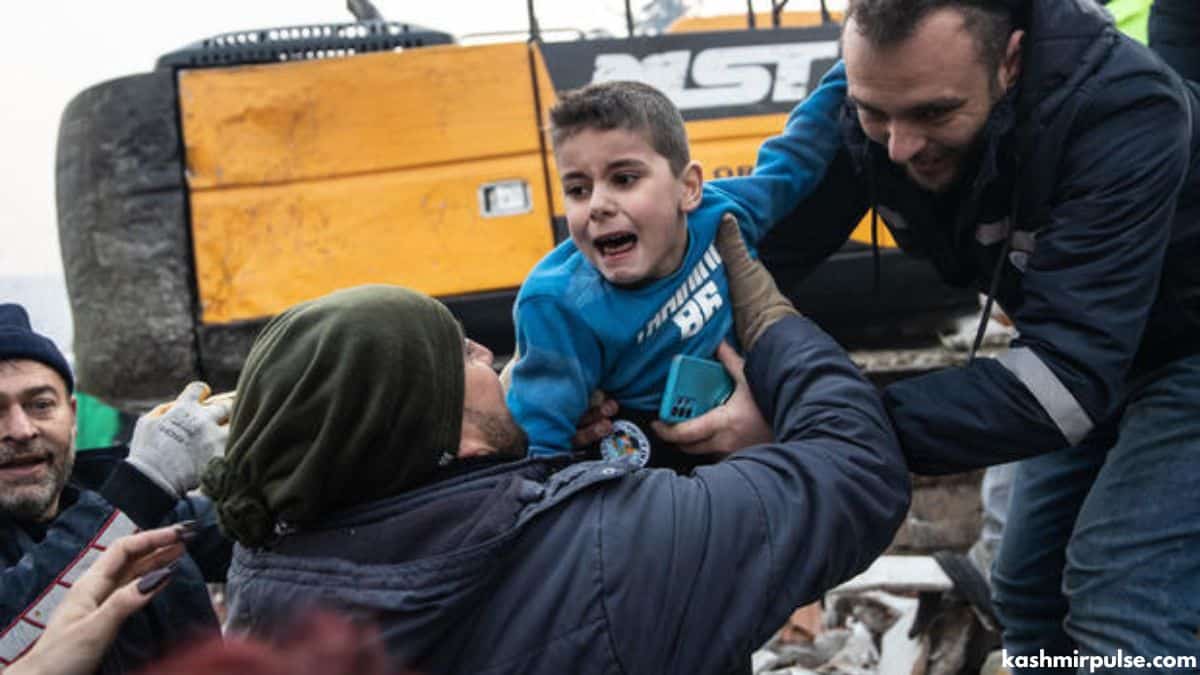
Stories of rescues did continue to provide hope, however. Nearly two days after the quakes, rescuers pulled a 3-year-old boy, Arif Kaan, from beneath the rubble of a collapsed apartment building in Kahramanmaras, which isn't far from the epicenter.

With the boy's lower body trapped under slabs of concrete and twisted rebar, emergency crews spread a blanket over his torso to protect him from below-freezing temperatures as they carefully cut the debris away from him, mindful of the possibility of triggering another collapse.

The boy's father, Ertugrul Kisi, who himself had been rescued earlier, sobbed as his son was pulled free and loaded into an ambulance. "For now, the name of hope in Kahramanmaras is Arif Kaan," a Turkish television reporter proclaimed as the dramatic rescue was broadcast to the country.

Many survivors in Turkey have had to sleep in cars, outside or in government shelters.

"We don't have a tent, we don't have a heating stove, we don't have anything. Our children are in bad shape. We are all getting wet under the rain and our kids are out in the cold," Aysan Kurt, 27, told The Associate Press. "We did not die from hunger or the earthquake, but we will die freezing from the cold."

As many as 23 million people could be affected in the quake-hit region, according to Adelheid Marschang, a senior emergencies officer with the World Health Organization, who called it a "crisis on top of multiple crises."

Erdogan, on his tour of quake-hit areas, acknowledged that there were problems early on in the response but said it had improved. He said his government would distribute the equivalent of $532 to affected families.

The disaster comes at a sensitive time for Erdogan, who faces presidential and parliamentary elections in May amid an economic downturn and high inflation. Perceptions that his government mismanaged the crisis could severely hurt his standings.

The region sits on top of major fault lines and is frequently shaken by earthquakes. Some 18,000 were killed in similarly powerful earthquakes that hit northwest Turkey in 1999.

This post first appeared on The Kashmir Pulse

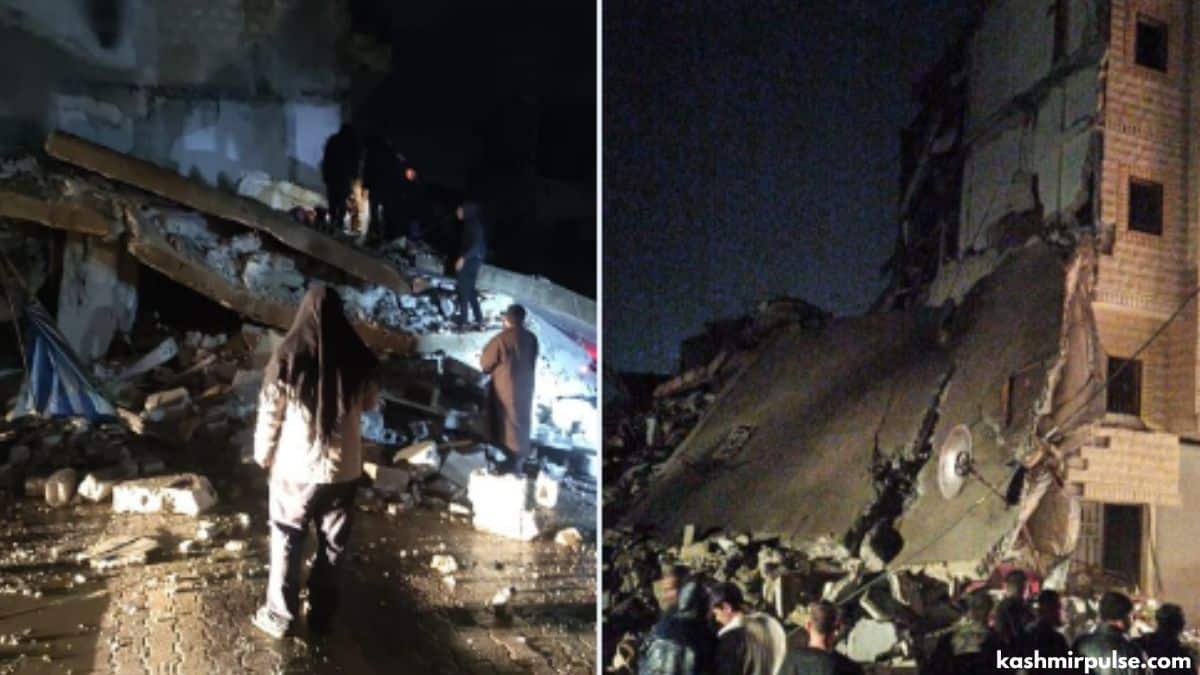
ANKARA (TURKEY) — A major earthquake of magnitude 7.8 struck central Turkey and north-west Syria early on Monday morning, killing at least 1,200 people and injuring thousands as buildings collapsed across the region, triggering searches for survivors in the rubble.

Turkey’s president, Recep Tayyip ErdoÄŸan, said 912 people had been killed in Turkey, with 5,383 wounded. He said authorities were unable to predict how high the toll may rise as search and rescue operations continued, Reuters report. He said 45 countries had so far offered assistance.

Syria’s state news agency reported more than 320 dead in the country, with over 1,000 wounded. The White Helmets rescue service reported that 147 people had died and more than 340 were injured in Syria in areas where it operates, which are unlikely to have been included in the official state figures.

The quake hit at 4:17 AM local time (0117 GMT) and was felt in Syria, Lebanon, Cyprus, Greece and Israel. The quake was centered about 32 km (20 miles) from Gaziantep, a major city and provincial capital in the country’s southeast, and about 26 km (16 miles) from the town of Nurdağı.

It was 17.7 km (11 miles) deep, according to the US Geological Survey. A strong 6.7 temblor rumbled about 10 minutes later.

ErdoÄŸan spoke by telephone with the governors of eight affected provinces to gather information on the situation and rescue efforts, his office said in a statement.

The Turkish interior minister, Süleyman Soylu, said 10 cities had been affected by the quake. Speaking to reporters on Monday, the official said the cities of Gaziantep, Kahramanmaraş, Hatay, Osmaniye, Adıyaman, Malatya, Şanlıurfa, Adana, Diyarbakır and Kilis had all suffered damage.

This post first appeared on The Kashmir Pulse
Powered by Blogger.