TOKYO (JAPAN) — A groundbreaking study conducted by researchers from Tokyo University of Science has shed light on the significant role of oxytocin (OXT) in enhancing memory function.

Published on November 16, 2023, in PLOS One, the study reveals how activation of neurons in the supramammillary nucleus (SuM) of the mouse brain boosts performance in object recognition tasks, suggesting a crucial link between specific oxytocin neurons and memory modulation in mice.

Unraveling Neural Pathways

Oxytocin, known for its effects on psychological well-being and emotional bonding in animals, has recently been implicated in various cognitive processes, including learning and memory.

Led by Professor Akiyoshi Saitoh and Junpei Takahashi, the researchers aimed to unravel the neural pathways and signalling mechanisms underlying oxytocin's impact on memory.

Prof. Saitoh explains that to investigate the role of endogenous oxytocin in cognitive function, they used pharmacogenetic techniques to activate oxytocin neurons in specific brain regions. The team then evaluated the cognitive function of mice using the Novel Object Recognition Task (NORT).
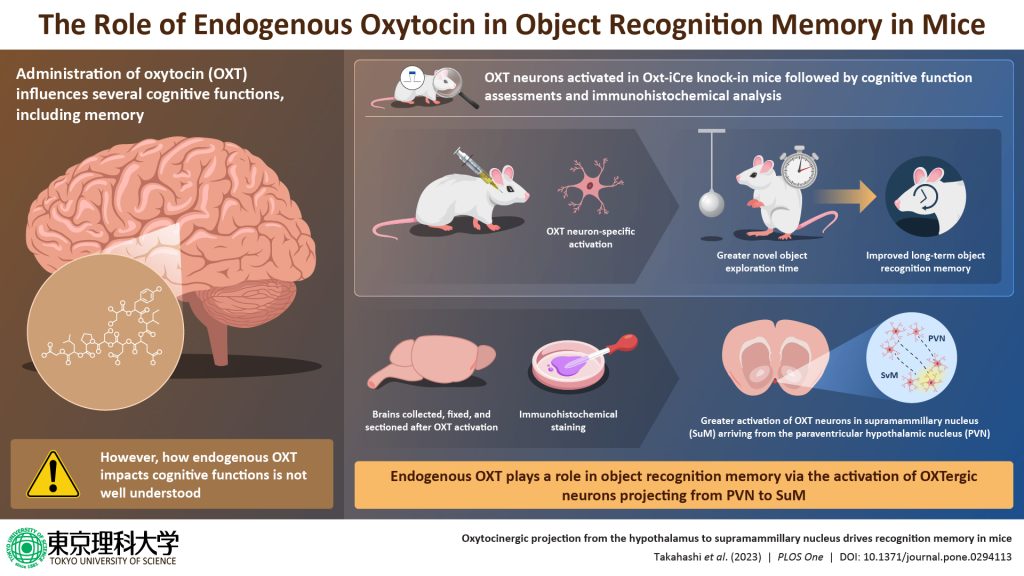
Role of Endogenous Oxytocin in Object Recognition Memory in Mice

Insights from the NORT

The study highlights the crucial role of oxytocin in regulating social memory, with a deficiency in oxytocin or its receptors linked to abnormal social memory in mice. However, this research shifts the focus to the role of endogenous oxytocinergic projections in learning and memory, particularly within the SuM.

To pinpoint the neurons responsible for oxytocin's effect on memory, the researchers visualized slices of the mouse brain after specifically activating oxytocin neurons in the paraventricular hypothalamic nucleus (PVN). Positive signals were observed in the PVN and its projections to the SuM, indicating oxytocin's involvement in memory enhancement.

Advancing Research in Memory Modulation

Further experiments using the Y-maze and NORT revealed that activation of oxytocinergic neurons significantly boosted long-term object recognition memory, with increased neuron activation observed in the SuM and the dentate gyrus of the hippocampus, crucial regions for memory processing.

Oxytocin's Role in Memory Enhancement and Dementia Prevention

This study, Prof. Saitoh says, uncovers the involvement of oxytocin in object recognition memory through the SuM, with potential implications for understanding Alzheimer's disease. "Our research seeks to elucidate the crucial role of a stimulating environment that activates oxytocin in the brain, potentially mitigating the progression of dementia,” explains Prof. Saitoh.

The ongoing exploration of oxytocin's role in memory modulation holds promise for innovative treatments and pharmaceutical interventions aimed at halting the advancement of dementia.

The study signifies a significant step forward in understanding the intricate relationship between oxytocin and memory function, paving the way for future research in neurological disorders and potential therapeutic interventions.

This post first appeared on The Kashmir Pulse

In today’s digital world, it is easy to find information on virtually any topic. However, just because something can be found online doesn’t necessarily mean that it is reliable and trustworthy. That being said, discerning between reliable sources of information and those which are not can be tricky – especially for someone who is new to the research process.

Research is important for any project, so it is important to make sure you are using reliable sources of information. For example, most sports bettors do research to get the best betting odds like the NCAAB odds and predictions to help them place their bets. The same goes for any project, as research is key to getting the best results. So, this article will share some strategies for doing research based on relevant and reliable sources of information.

Strategies for gathering and analyzing research data

When it comes to gathering and analyzing research data, there are a few strategies that can help ensure accuracy and reliability. First, it is important to create a plan for the research process. This should include an outline of the steps needed to collect data, as well as any potential sources of bias or error that could affect the results. Once this plan is in place, you should begin collecting data from multiple sources. This could include surveys, interviews, focus groups, or other methods of gathering information.

After all the data has been collected, you should analyze it using statistical techniques such as regression analysis or factor analysis. You should interpret your findings and draw conclusions based on your results.

Creative approaches to qualitative and quantitative research

For creative approaches to qualitative and quantitative research, you can use mixed methods – combining both qualitative and quantitative techniques – for a more comprehensive view of the subject matter. You can also employ visual methods such as photography or video recordings to capture people’s reactions or behaviors in real-time.

In addition, you can use storytelling techniques such as narrative interviews or case studies to explore complex topics from multiple perspectives. You can also utilize technology-based tools such as virtual reality simulations or online surveys for gathering data in innovative ways.

What resources are available for finding reliable sources for research?

There are a number of resources available. One of the best places to start is your local library. Libraries often have an extensive collection of books and other materials that can be used for research. Many libraries offer access to online databases such as JSTOR and ProQuest which provide access to scholarly articles and other academic resources.

Another great resource is the internet. There are numerous websites that provide access to reliable sources. These sites allow you to search for specific topics or keywords related to your research topic and find relevant articles from reputable journals or publications.

If you’re looking for more specialized information, consider reaching out directly to experts in the field who may be able to provide additional insight into your topic or direct you to additional resources.

To conclude, use multiple sources, read critically, check for bias and accuracy, and verify the information to ensure the sources you use are relevant and reliable.

This post first appeared on The Kashmir Pulse
Powered by Blogger.