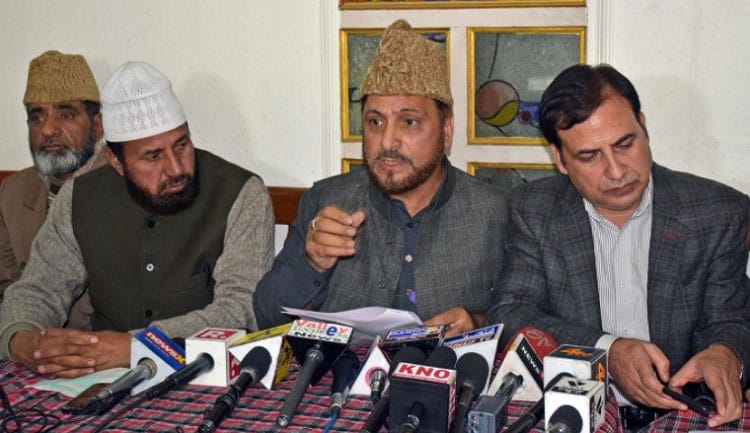
SRINAGAR — The Ramadan moon has been sighted in Jammu and Kashmir this evening, Grand Mufti, Jammu and Kashmir, Mufti Nasir ul Islam Farooqi, announced.

“Ramzan crescent of 1445 AH was sighted in different parts of Jammu and Kashmir and the holy month commences this evening with the first day of the month of fasting to be marked tomorrow,” Mufti Nasir ul Islam said, as per the news agency GNS.

He conveyed that the announcement is being made after consultations with other respected members.

Greeting the people, the Grand Mufti prayed that the Almighty Allah ease the hardships and shower his blessings and bring peace and prosperity during this holy month to everyone.

This post first appeared on The Kashmir Pulse

SRINAGAR — Jammu and Kashmir’s Grand Mufti Mufti Nasir-ul-Islam on Tuesday said that the moon for Muharram-ul-Haram, the first month of the Islamic calendar, was not sighted anywhere and that Thursday would be the first day of the new Islamic Year – 1445 AH.

Talking to the news agency KNO, the Grand Mufti said that no witnesses could be made available on record regarding the sighting of the moon from any part of Kashmir or Jammu divisions.

“The Islamic New Year will now start from Thursday, July 20, and the Ashura will be observed on July 29,” he said.

In his message to Muslims of J&K, Grand Mufti urged Muslims to observe the ensuing Ashura with austerity and asked them to pray for the overall well-being of the Ummah, especially of the youth.

“People should refrain from indulging in immodest activities in the month of Muharram,” he said and added, “The Ashura has a fundamental message that we should not bow before falsehood and instead remain steadfast on what our religion teaches us.”

The Grand Mufti said Muhrram teaches us to remain steadfast on the path of Islam and follow in the footsteps of Hazrat Imam Hussain (AS), who was martyred along with 70 of his family members in the battle of Karbala some 1400 years ago.

This post first appeared on The Kashmir Pulse

Islam is a religion that begins as well as ends on sacrifice. The first month of the Islamic calendar starts with the martyrdom of Hazrat Imam Hussain and his companions, in Karbala and ends with the sacrifice of Hazrat Abraham, when he was to sacrifice his son in the way of Allah, to test his loyalty and to make him a role model to be followed by Hazrat Usmaan and Hazrat Imam Hussain, respectively. But here we are going to talk about the lessons taught by the event of Karbala.

There are many lessons to be learnt from the unique event. A reasonable person can draw many lessons from Karbala. It should be kept in mind that barring prejudiced minds, no one can deny the universal messages of Muharram or Karbala. The lessons we keep learning from Karbala are discussed in the coming lines.

The first is giving one’s life for truth. Muharram teaches us that for the sake of truth, life must be sacrificed so that truth doesn’t die. Imam Hussain did the same. At that time, there were many pious people, who were deeply religious, but they were not ready to do what Imam Hussain and his Companions did.

At that time, Madina was the centre of religious rituals and customs, but at the helm of affairs, there were the people, who would use religion for some gains, but no one could afford to challenge the authority. However, it was only Imam Hussain and his progeny, who, for the sake of Islam, sacrificed their lives for the truth and that is the noble cause.

The second is preferring long-lasting gains over short-term gains. Imam Hussain and his family didn’t crave for worldly belongings. However, if they had craved for it, they would have got it. But they knew this fact that their home was the home, where Allah’s angels used to visit. It was the home where the world has no importance. It was the home, where the rivers of morality used to flow.

In the home of humility, materialism has no value. Wealth, lavish buildings, sweet dishes, slaves at service, etc., were useless in their eyes. Keeping these teachings in mind, Imam Hussain was brought up. It left an indelible mark on his life and paved the way for Karbala.

The third is love for Allah. The aim of life is to please Allah. This aim was always in the eyes of Imam Hussain. All the worldly things, plus our beautiful bodies, are Allah’s gifts. If these are sacrificed in the way of Allah, then it is a source of eternal happiness. The Giver takes back the things, which He had given us as gifts for a time being to be taken care of. This truth was given the practical shape by Imam in the hot sands of Karbala.

The fourth and last is to live for a cause. Imam had a cause to live for. Islam was completed in his house and he made its protection and to be Allah’s religion’s supporter, the cause to live for. At that time, there were many causes to live for. He could have remained silent and enjoyed every luxury. But he could not afford to follow others and see his grandfather’s religion manipulated by so-called champions of Islam. Imam's cause is Karbala's message.

In short, Muharram teaches the universal message of truth, loyalty, honesty, sacrificing one’s life for the sake of truth, etc., that are to be followed in letter and spirit. Commemorating martyrs on this occasion is a pious job, but how far we have been able to universalize the message of Muharram, is a question to be asked.

Muharram, which is a significant month in the Islamic calendar, is not facing challenges from outside forces. Instead, the challenges associated with Muharram are arising from within the community. In other words, the problems and obstacles related to the observance or commemoration of Muharram are internal issues that the community needs to address and resolve from within. These internal challenges could be related to how people observe the month, understand its significance, or uphold its teachings and values. The focus should be on addressing these internal issues to better preserve the true spirit and meaning of Muharram.

In our ranks, there are people like those, who shed the blood of Imam and his family. There are 57 Muslim countries, which can become one in the name of Imam Hussain and disseminate the real message of Karbala. How long shall we remember Imam for a specific number of days? It is a shame for us.

In our homes, there is no Hussainiyat. However, our homes are the homes of Yazidiyat. Throw out Yazids from your hearts, homes, societies, etc. If not, then Imam has to come back again to get martyred for the sake of our survival. Long live Islam! May Allah be pleased with Imam and his family!

This post first appeared on The Kashmir Pulse

SRINAGAR — Eid-i-Milad-un-Nabi (SAW) was celebrated with full reverence, devotion and religious fervour across Kashmir valley on Sunday. The day marks the birth anniversary of the Prophet Muhammad (SAW).

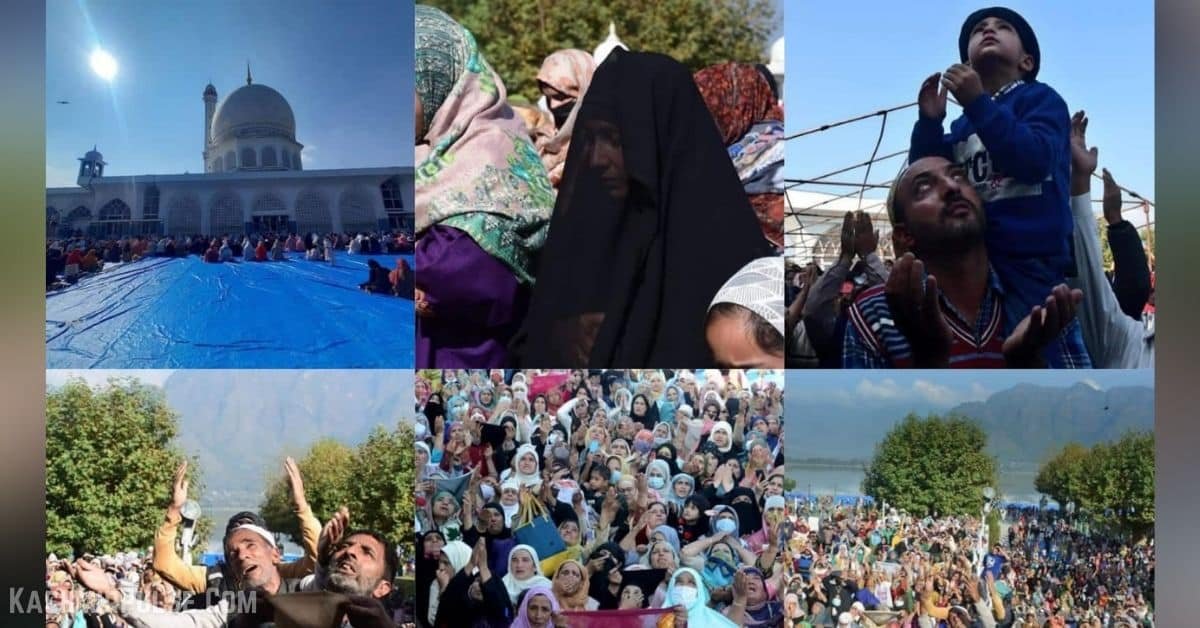
Special religious functions were held in Kashmir at various shrines and Masjids. The biggest congregation was held at Hazratbal shrine in Srinagar where devotees in large numbers offered special prayers and had glimpses of the holy relic of Prophet Muhammad (SAW).

An official told the news agency KNS that thousands of devotees from different parts of the Valley thronged Dargah Hazratbal shrine to see the relic of the Prophet (SAW).

In south Kashmir, thousands of people offered prayers at Masjids and shrines, mainly at Jamia Masjid Reshi Sahab, Khiram Sirhama, Kaba Marg, Dooru and Seer Hamdan while in north Kashmir, Milad procession was taken out at various places.

Meanwhile, Waqf Board Chairperson Dr Darakshan Andrabi took out Milad-un-Nabi (SAW) procession for the first time from Nigeen Club to Dargah Hazratbal in Srinagar.

Divisional Commissioner Kashmir PK Pole said that all arrangements were put in place at Hazratbal and other shrines across Kashmir for the convenience of devotees. "All departments including the Power Development Department and Health Department had made requisite arrangements," the Divisional Commissioner said.

Meanwhile, the Traffic Police had made arrangements for the smooth passage of vehicular movement in view of the Eid Milad-un-Nabi (SAW).

This post first appeared on The Kashmir Pulse

SRINAGAR — Sadaqat al-Fitr, also known as Zakat al-Fitr, amount has been fixed at Rs 65 per person, Jammu and Kashmir’s Grand Mufti, Nasir-ul-lslam announced on Monday.

Talking to the news agency Kashmir News Observer (KNO), Grand Mufti said that Sadaqat al-Fitr is a duty required of every Muslim and becomes obligatory to pay it before the beginning of Eid prayer and could be given from the beginning of the holy month of Ramadan.

He said the main purpose of Zakat al-Fitr is to provide the poor with a means with which they can celebrate the festival Eid al-Fitr along with the rest of the Muslims.

Mufti Nasir-ul-Islam urged people to ensure Fitr money reaches the poor and destitute before Eid. "It is better to prefer poor and destitute over Darul-Ulooms," he said.

Quoting Hadith, he said: "Every Muslim is required to pay Zakat al-Fitr at the conclusion of the month of Ramadan as a token of thankfulness to Allah for having enabled him or her to observe the obligatory fast. Its purpose is: as a levy on the fasting person. The fasting person will be hanging between the Earth and heavens and it will not be raised up to the Divine Presence without paying the Zakat al-Fitr."

He said that it can be given to the poor and needy but not for the construction purposes of Masjids and any other structures. "There is no harm for any person who is wealthier and wants to pay more than Rs 65 per person as fixed for this year," he said.

This post first appeared on The Kashmir Pulse
Powered by Blogger.