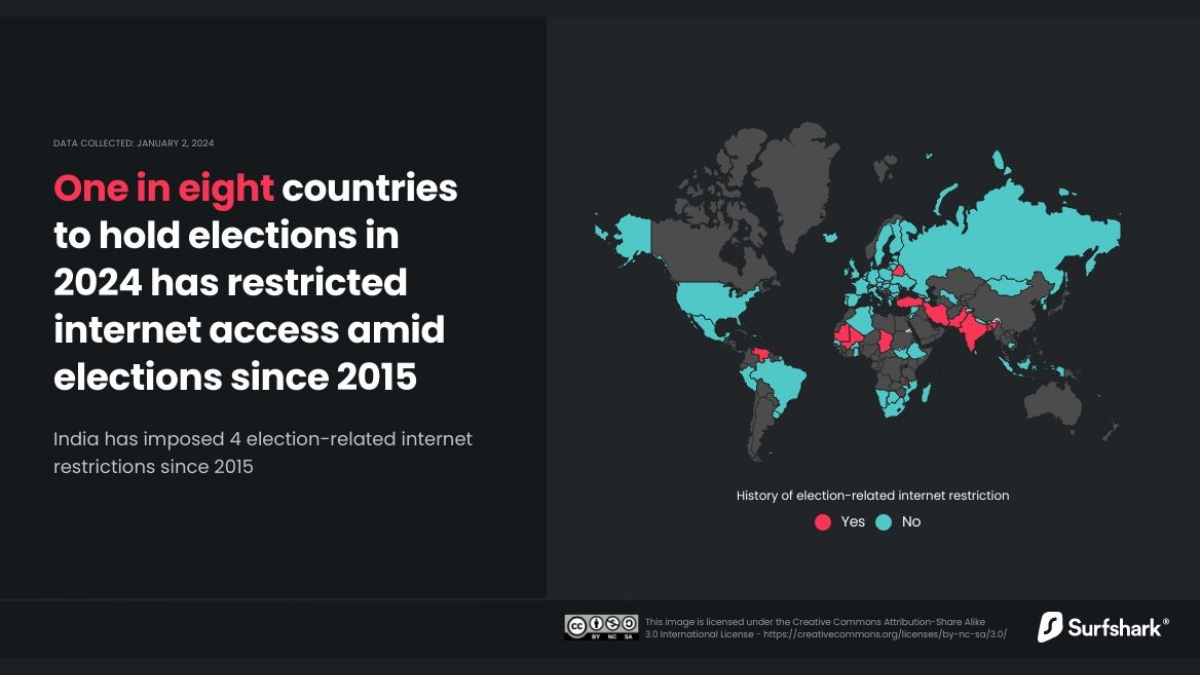
NEW DELHI — In preparation for the impending 2024 elections across 90 nations, Surfshark's Research Hub has unveiled a comprehensive analysis exposing a disturbing global trend – increased internet restrictions jeopardizing the integrity of electoral processes. The report reveals a correlation between internet blackouts and compromised freedoms, as governments manipulate digital communication to control public narratives.

Lead Researcher Agneska Sablovskaja warns that election season often brings a wave of internet shutdowns around the world. He informed that their Research Hub's examination of internet freedom in 196 countries indicates a significant link between digital censorship and broader violations of personal, civil, and economic freedoms.

The study finds that among the countries gearing up for elections in 2024, 12 have a history of imposing internet restrictions during electoral periods. Since 2015, 75% of these interventions involved severing network connectivity, disrupting the essential flow of information crucial for transparent electoral processes. Other measures predominantly included social media blackouts, hindering citizens' communication, organization, and ability to voice objections.

Sub-Saharan Africa and Southern Asia under scrutiny

The report sheds light on the disproportionate impact on specific regions, with Sub-Saharan Africa leading with 29 reported cases of election-related internet censorship since 2015, closely followed by Southern Asia with 28 incidents. Countries in these areas, including Mali, Malawi, Chad, Mauritania, India, Iran, Pakistan, and Bangladesh, face heightened risks of internet blackouts as their elections approach.

The spring season presents significant challenges for India and Iran, gearing up for parliamentary elections under the shadow of their records of internet clampdowns. India, with four instances since 2015, and Iran, with three, are displaying worrisome patterns that suggest a continuation of digital suppression tactics in the upcoming elections.

Additionally, Belarus, entering the election arena with its upcoming parliamentary elections, raises concerns based on the extensive internet disruptions experienced during its latest presidential election. The strategic blocking of social media channels, particularly Twitter, highlights a trend of stifling political participation and societal dialogue through digital means.

As nations gear up for 2024 elections, Surfshark's findings underscore the pressing need for vigilance against the escalating threat to internet freedom during critical democratic processes.

This post first appeared on The Kashmir Pulse

NEW DELHI — Surfshark, a cybersecurity company, has conducted a comprehensive analysis of the 2021 UN Human Rights Council (UNHRC) resolution on human rights on the internet. The study revealed that despite supporting the resolution, India and 13 other countries have imposed significant internet restrictions, raising concerns about their commitment to safeguarding online freedoms.

Analyzing UN resolution and Surfshark's Internet Shutdown Tracker

The UN resolution on human rights on the internet aims to protect and promote the fundamental rights of individuals in the digital realm. Surfshark undertook an examination of countries' positions in the resolution and cross-referenced them with data from their Internet Shutdown Tracker.

This analysis allowed Surfshark to identify 14 countries that not only pledged their support for the resolution but also violated their commitment by implementing internet restrictions.

Governments manipulating public and stifling free speech

In an era where internet shutdowns have become a grave concern, authoritarian governments frequently exploit such measures to manipulate the public and suppress free speech. The UN resolution seeks to openly condemn these shutdowns and other forms of online speech restrictions.

However, it is disconcerting that despite public support for the resolution, 14 countries resorted to imposing internet restrictions. It is crucial to promote an open and accessible internet and exert pressure on nations to uphold their commitments concerning human rights online.

According to Gabriele Racaityte-Krasauske, Surfshark spokeswoman, "In today's world, internet shutdowns have become a major concern. The UN resolution on human rights on the internet aims to make countries openly condemn these shutdowns and other ways of restricting online speech. It's important to promote an open and accessible internet and pressure countries to uphold their commitments regarding human rights online."

Countries violating the pledge

The countries identified by Surfshark's analysis include India, Sudan, Cuba, Uzbekistan, Burkina Faso, Pakistan, Russia, Brazil, Armenia, Indonesia, Mauritania, Nigeria, Somalia, and Ukraine. Surfshark's Internet Shutdown Tracker has recorded a total of 58 internet disruptions in these 14 countries during or after the adoption of the resolution.

Most of the restrictions on internet were placed in India, says SurfShark study
Most of the restrictions on free internet were placed in India, says SurfShark study

India's troubling record

Among the countries, India stands out as the most significant violator, with 19 instances of internet disruptions since the adoption of the resolution in 2021. It is worth noting that if we include the Jammu & Kashmir region, the number of disruptions would be even higher, amplifying concerns about the country's commitment to a free and open internet.

Other notable offenders

Sudan follows closely with nine restrictions, the first occurring amidst the 2021 military coup. Meanwhile, Nigeria and Ukraine had ongoing restrictions at the time of the resolution's adoption but did not impose new restrictions since then. Nigeria had banned Twitter a month prior to the adoption, and the ban persisted until January 2022.

Ukraine's blocking of popular Russian apps in 2017 as part of sanctions in response to the annexation of Crimea remains in effect. It is important to note that Ukraine's case cannot be classified as anti-democratic censorship but rather as a response to counter Russian propaganda.

Looking ahead and holding nations accountable

The Human Rights Council convenes regular sessions to address crucial global issues, including human rights on the internet. The upcoming 53rd session in the summer of 2023 will play a significant role in shaping the agenda regarding these rights.

Surfshark remains vigilant in monitoring any updates related to UN resolutions on human rights on the internet, emphasizing the need to hold nations accountable for their actions.

Conclusion

Surfshark's study shines a light on the disconcerting actions of countries that publicly supported the UN resolution on human rights on the internet but subsequently violated their commitments.

With the proliferation of internet restrictions globally, it is essential to ensure an open and accessible internet that respects individuals' rights. Continued scrutiny and pressure are crucial to encouraging governments to uphold their pledges and protect online freedoms for all.

This post first appeared on The Kashmir Pulse
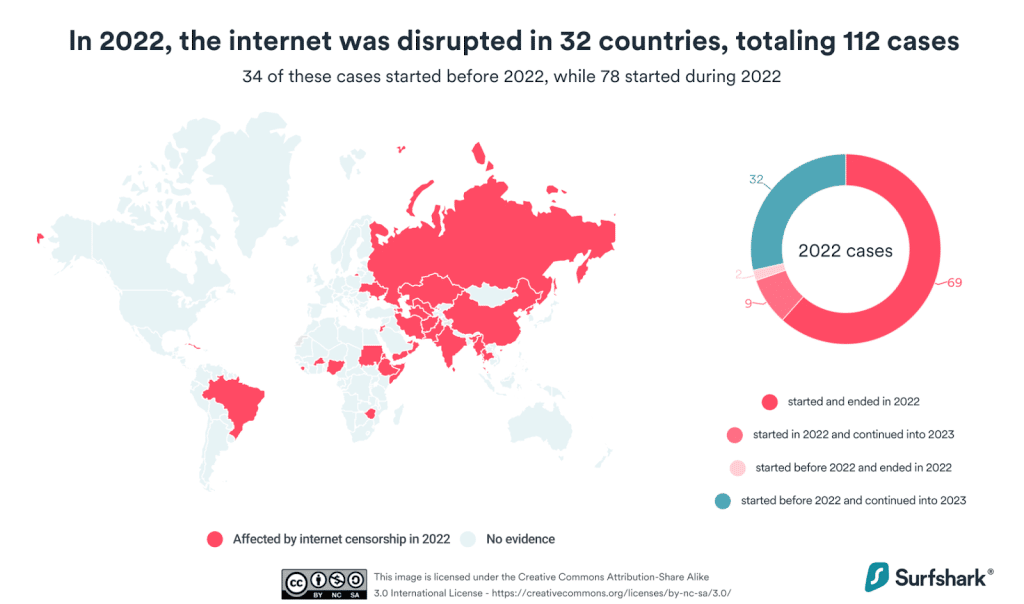
NEW DELHI — Surfshark’s internet censorship yearly recap shows that 4.2 billion people were affected by internet censorship in 2022 globally, while Asia accounts for nearly half (47%) of all new cases in 2022. The Jammu and Kashmir region took the lead by case count, with 24 recorded internet disruptions. 10 additional cases were recorded across the rest of India.

"Internet censorship remains a common technique used by autocratic governments to isolate their citizens from the outside world," a press statement issued by Surfshark said.

Surfshark spokeswoman Gabriele Racaityte-Krasauske added, “More than half of the world’s population was affected by internet censorship last year. Many of these cases involved full internet disruptions on a local or national level. These can be devastating and extremely dangerous, especially during wartime, protests, or violent government repressions. Internet restrictions can make it difficult or even impossible to mobilize people for the defense of democracy, contact loved ones, access news sites, and spread information to the outside world on what’s happening.”

Overview of internet ban in 2022, globally
Graphical representation of internet bans in 2022, globally

"Through the past year, we’ve seen how governments have used internet shutdowns and telecommunications blackouts as a tool of repression and control, silencing journalists, civil society, and the general public. Internet connectivity today underpins all human rights, which is why it’s more critical than ever to document mass-censorship incidents and find ways to get people reconnected," Alp Toker, Director, NetBlocks, opines.

Asia continues to lead by internet disruption count

11 Asian countries imposed new internet disruptions in 2022, bringing a total of 58 cases. The Jammu and Kashmir region has the highest disruption count in the world (24), followed by Iran (11) and the rest of India (10).

Africa follows Asia as the second most disruption-intensive region, with 5 countries imposing 13 restrictions. Sudan takes the lead in Africa by disruption count (4), followed by Burkina Faso (3) and Zimbabwe (3).

Here are a few of the most worrisome internet censorship events in Asia in 2022:

  • June - India disrupts internet access amid military recruitment protests.
  • September - Mass-scale internet disruptions in Iran in the wake of Mahsa Amini’s death.
  • Jammu and Kashmir region accounted for 24 new disruption cases in 2022 - more cases than any country in the world.

Burkina Faso, Russia, and Azerbaijan had the longest internet disruptions last year

  • Burkina Faso restricted Facebook in January. The restriction continued into 2023.
  • Russia’s Twitter, Facebook and Instagram disruptions following the invasion of Ukraine are still ongoing. The country has also blocked access to major international news sites.
  • Azerbaijan restricted TikTok in September. The platform remains restricted to this day.

Of all social media platforms, Facebook is the most hated by autocratic governments and remains highly censored in 2022. In fact, since 2015, a staggering 46% of the global population has, in some way or another, been affected by government-imposed Facebook restrictions.

The Internet Censorship Tracker was developed by Surfshark in partnership with internet watchdog NetBlocks. The research tracks partial and complete internet and social media shutdowns in 196 countries and territories from 2015 onwards.

Here are the key takeaways:

4.2 billion people were affected by internet censorship in 2022 globally.
Asia accounts for nearly half (47%) of all new cases in 2022, which is more than any other continent.
The Jammu & Kashmir region had the highest number of restrictions (24) - this is more than any country in the world.
The main causes of internet censorship in 2022 were protests and political turmoil.
Facebook was the most-restricted social media platform in 2022.
This post first appeared on The Kashmir Pulse
Powered by Blogger.