NEW DELHI — Surfshark, a cybersecurity company, has conducted a comprehensive analysis of the 2021 UN Human Rights Council (UNHRC) resolution on human rights on the internet. The study revealed that despite supporting the resolution, India and 13 other countries have imposed significant internet restrictions, raising concerns about their commitment to safeguarding online freedoms.

Analyzing UN resolution and Surfshark's Internet Shutdown Tracker

The UN resolution on human rights on the internet aims to protect and promote the fundamental rights of individuals in the digital realm. Surfshark undertook an examination of countries' positions in the resolution and cross-referenced them with data from their Internet Shutdown Tracker.

This analysis allowed Surfshark to identify 14 countries that not only pledged their support for the resolution but also violated their commitment by implementing internet restrictions.

Governments manipulating public and stifling free speech

In an era where internet shutdowns have become a grave concern, authoritarian governments frequently exploit such measures to manipulate the public and suppress free speech. The UN resolution seeks to openly condemn these shutdowns and other forms of online speech restrictions.

However, it is disconcerting that despite public support for the resolution, 14 countries resorted to imposing internet restrictions. It is crucial to promote an open and accessible internet and exert pressure on nations to uphold their commitments concerning human rights online.

According to Gabriele Racaityte-Krasauske, Surfshark spokeswoman, "In today's world, internet shutdowns have become a major concern. The UN resolution on human rights on the internet aims to make countries openly condemn these shutdowns and other ways of restricting online speech. It's important to promote an open and accessible internet and pressure countries to uphold their commitments regarding human rights online."

Countries violating the pledge

The countries identified by Surfshark's analysis include India, Sudan, Cuba, Uzbekistan, Burkina Faso, Pakistan, Russia, Brazil, Armenia, Indonesia, Mauritania, Nigeria, Somalia, and Ukraine. Surfshark's Internet Shutdown Tracker has recorded a total of 58 internet disruptions in these 14 countries during or after the adoption of the resolution.

Most of the restrictions on internet were placed in India, says SurfShark study
Most of the restrictions on free internet were placed in India, says SurfShark study

India's troubling record

Among the countries, India stands out as the most significant violator, with 19 instances of internet disruptions since the adoption of the resolution in 2021. It is worth noting that if we include the Jammu & Kashmir region, the number of disruptions would be even higher, amplifying concerns about the country's commitment to a free and open internet.

Other notable offenders

Sudan follows closely with nine restrictions, the first occurring amidst the 2021 military coup. Meanwhile, Nigeria and Ukraine had ongoing restrictions at the time of the resolution's adoption but did not impose new restrictions since then. Nigeria had banned Twitter a month prior to the adoption, and the ban persisted until January 2022.

Ukraine's blocking of popular Russian apps in 2017 as part of sanctions in response to the annexation of Crimea remains in effect. It is important to note that Ukraine's case cannot be classified as anti-democratic censorship but rather as a response to counter Russian propaganda.

Looking ahead and holding nations accountable

The Human Rights Council convenes regular sessions to address crucial global issues, including human rights on the internet. The upcoming 53rd session in the summer of 2023 will play a significant role in shaping the agenda regarding these rights.

Surfshark remains vigilant in monitoring any updates related to UN resolutions on human rights on the internet, emphasizing the need to hold nations accountable for their actions.

Conclusion

Surfshark's study shines a light on the disconcerting actions of countries that publicly supported the UN resolution on human rights on the internet but subsequently violated their commitments.

With the proliferation of internet restrictions globally, it is essential to ensure an open and accessible internet that respects individuals' rights. Continued scrutiny and pressure are crucial to encouraging governments to uphold their pledges and protect online freedoms for all.

This post first appeared on The Kashmir Pulse

In today’s digital world, it is easy to find information on virtually any topic. However, just because something can be found online doesn’t necessarily mean that it is reliable and trustworthy. That being said, discerning between reliable sources of information and those which are not can be tricky – especially for someone who is new to the research process.

Research is important for any project, so it is important to make sure you are using reliable sources of information. For example, most sports bettors do research to get the best betting odds like the NCAAB odds and predictions to help them place their bets. The same goes for any project, as research is key to getting the best results. So, this article will share some strategies for doing research based on relevant and reliable sources of information.

Strategies for gathering and analyzing research data

When it comes to gathering and analyzing research data, there are a few strategies that can help ensure accuracy and reliability. First, it is important to create a plan for the research process. This should include an outline of the steps needed to collect data, as well as any potential sources of bias or error that could affect the results. Once this plan is in place, you should begin collecting data from multiple sources. This could include surveys, interviews, focus groups, or other methods of gathering information.

After all the data has been collected, you should analyze it using statistical techniques such as regression analysis or factor analysis. You should interpret your findings and draw conclusions based on your results.

Creative approaches to qualitative and quantitative research

For creative approaches to qualitative and quantitative research, you can use mixed methods – combining both qualitative and quantitative techniques – for a more comprehensive view of the subject matter. You can also employ visual methods such as photography or video recordings to capture people’s reactions or behaviors in real-time.

In addition, you can use storytelling techniques such as narrative interviews or case studies to explore complex topics from multiple perspectives. You can also utilize technology-based tools such as virtual reality simulations or online surveys for gathering data in innovative ways.

What resources are available for finding reliable sources for research?

There are a number of resources available. One of the best places to start is your local library. Libraries often have an extensive collection of books and other materials that can be used for research. Many libraries offer access to online databases such as JSTOR and ProQuest which provide access to scholarly articles and other academic resources.

Another great resource is the internet. There are numerous websites that provide access to reliable sources. These sites allow you to search for specific topics or keywords related to your research topic and find relevant articles from reputable journals or publications.

If you’re looking for more specialized information, consider reaching out directly to experts in the field who may be able to provide additional insight into your topic or direct you to additional resources.

To conclude, use multiple sources, read critically, check for bias and accuracy, and verify the information to ensure the sources you use are relevant and reliable.

This post first appeared on The Kashmir Pulse

NEW DELHI — Surfshark recently released the Global Internet Value index (IVi), which uncovers countries that are overpaying for their internet connection plan. India is in 44th place in the world, with an index 26% lower than the global average. Oceania and Europe lead the world in internet value, while internet affordability in North America, South America, and Africa is below average. Globally, only 4 out of 10 people get their internet at fair prices, while the remaining 61% overpay for the internet they get.

Global Internet Value index (IVi) is calculated by dividing each country’s internet speed by internet affordability to determine which countries are overpaying for their internet. According to Surfshark’s data, India ranks 44th globally with an index of 0.0542, which is 26% lower than the global average, meaning Indians are overpaying for the internet they get compared to other countries worldwide.

Regarding regional position, India ranks 10th, with its index 28% lower than Asia's average. India is in 1st place in Southern Asia. Countries like Bangladesh and Nepal rank 83rd and 77th, respectively, both overpaying for the internet they get. India has a 416% higher index compared to Bangladesh, and a 271% higher index compared to Nepal.

“Internet Value index offers to look at internet connection from a practical perspective - whether we get what we pay for. Even economically affluent countries with relatively fast internet can overpay compared to others worldwide,” says Agneska Sablovskaja, Lead Researcher at Surfshark. “However, some countries may have slower internet but also pay a considerably lower price, which is then considered fair.”

Out of the five Asian subregions, Eastern Asia has the best internet value

Four out of 10 people in Asia can access the internet at a fair price compared to the rest of the region. Out of the five Asian subregions, Southern Asia performs the worst, with its index 79% lower than the Asian average. Every country in Southern and Central Asia overpays for internet connections since they all have an internet value index lower than the regional average. Israel takes the lead in Asia with the best internet value index, followed by Singapore and South Korea.

Internet value across Asia
Graphical representation of internet value across Asia | Courtesy: Surfshark

Out of the five Asian subregions, Eastern Asia performs the best, with an index 64.5% higher than the Asian average. Pakistan and Tajikistan formed part of the three lowest-ranking Asian countries, while Yemen has the worst internet value index across Asia.

78% of European people get their internet at fair prices. Denmark takes the lead in Europe with an index nearly four times higher than the European average, closely followed by France. The three lowest-ranking countries: Bosnia and Herzegovina, Albania, and North Macedonia, are all located in Southern Europe.

In North America, seven out of every 10 individuals can access the internet at a fair price. The United States outperforms Canada regarding internet value. None of the countries that form part of the Latin American and the Caribbean subregion of North America have above-average internet value. 59% of South Americans get their internet at a fair price. Chile is South America's leader in internet value, followed by Uruguay and Brazil.

Oceania’s internet value index is 2.5 times higher than the global average. Australia ranked 5th in the world, and New Zealand ranked 25th overall.

Surfshark's study covers 117 countries

This study ranks 117 countries and territories based on the Internet Value index (IVi), which is determined by fixed broadband internet and mobile internet speed-to-affordability ratios.

Pillars have four indicators directly influencing the quality to affordability aspect: 1) time to work to afford fixed broadband internet (hours). 2) time to work to afford mobile internet (hours). 3) median fixed broadband download speed (Mbps). 4) median mobile internet download speed (Mbps).

Here are the key takeaways:

✹ India is in 44th place in the world, with an index 26% lower than the global average.
✹ In terms of regional position, India ranks 10th with its index 28% lower than Asia's average. India is in 1st place in Southern Asia.
✹ Indians get their internet for 416% more value compared to Bangladeshis and 271% more value compared to Nepalis.
✹ Oceania and Europe lead the world in internet value, while internet affordability in North America, South America, and Africa is below average.
✹ Globally, only 4 out of 10 people get their internet at fair prices, while the remaining 61% overpay for the internet they get - almost 5 billion people.
This post first appeared on The Kashmir Pulse
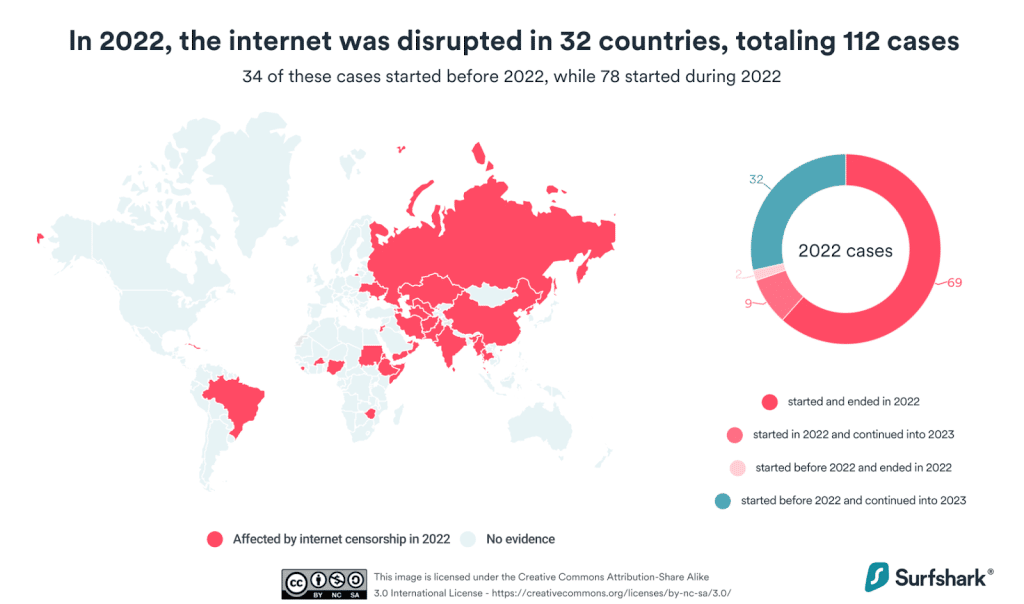
NEW DELHI — Surfshark’s internet censorship yearly recap shows that 4.2 billion people were affected by internet censorship in 2022 globally, while Asia accounts for nearly half (47%) of all new cases in 2022. The Jammu and Kashmir region took the lead by case count, with 24 recorded internet disruptions. 10 additional cases were recorded across the rest of India.

"Internet censorship remains a common technique used by autocratic governments to isolate their citizens from the outside world," a press statement issued by Surfshark said.

Surfshark spokeswoman Gabriele Racaityte-Krasauske added, “More than half of the world’s population was affected by internet censorship last year. Many of these cases involved full internet disruptions on a local or national level. These can be devastating and extremely dangerous, especially during wartime, protests, or violent government repressions. Internet restrictions can make it difficult or even impossible to mobilize people for the defense of democracy, contact loved ones, access news sites, and spread information to the outside world on what’s happening.”

Overview of internet ban in 2022, globally
Graphical representation of internet bans in 2022, globally

"Through the past year, we’ve seen how governments have used internet shutdowns and telecommunications blackouts as a tool of repression and control, silencing journalists, civil society, and the general public. Internet connectivity today underpins all human rights, which is why it’s more critical than ever to document mass-censorship incidents and find ways to get people reconnected," Alp Toker, Director, NetBlocks, opines.

Asia continues to lead by internet disruption count

11 Asian countries imposed new internet disruptions in 2022, bringing a total of 58 cases. The Jammu and Kashmir region has the highest disruption count in the world (24), followed by Iran (11) and the rest of India (10).

Africa follows Asia as the second most disruption-intensive region, with 5 countries imposing 13 restrictions. Sudan takes the lead in Africa by disruption count (4), followed by Burkina Faso (3) and Zimbabwe (3).

Here are a few of the most worrisome internet censorship events in Asia in 2022:

  • June - India disrupts internet access amid military recruitment protests.
  • September - Mass-scale internet disruptions in Iran in the wake of Mahsa Amini’s death.
  • Jammu and Kashmir region accounted for 24 new disruption cases in 2022 - more cases than any country in the world.

Burkina Faso, Russia, and Azerbaijan had the longest internet disruptions last year

  • Burkina Faso restricted Facebook in January. The restriction continued into 2023.
  • Russia’s Twitter, Facebook and Instagram disruptions following the invasion of Ukraine are still ongoing. The country has also blocked access to major international news sites.
  • Azerbaijan restricted TikTok in September. The platform remains restricted to this day.

Of all social media platforms, Facebook is the most hated by autocratic governments and remains highly censored in 2022. In fact, since 2015, a staggering 46% of the global population has, in some way or another, been affected by government-imposed Facebook restrictions.

The Internet Censorship Tracker was developed by Surfshark in partnership with internet watchdog NetBlocks. The research tracks partial and complete internet and social media shutdowns in 196 countries and territories from 2015 onwards.

Here are the key takeaways:

4.2 billion people were affected by internet censorship in 2022 globally.
Asia accounts for nearly half (47%) of all new cases in 2022, which is more than any other continent.
The Jammu & Kashmir region had the highest number of restrictions (24) - this is more than any country in the world.
The main causes of internet censorship in 2022 were protests and political turmoil.
Facebook was the most-restricted social media platform in 2022.
This post first appeared on The Kashmir Pulse

Online gaming is becoming increasingly popular in India, as more and more people are getting access to high-speed internet connections. This has led to a rise in the number of online gamers in the country, as people of all ages are taking advantage of the opportunities that online gaming provides.

However, while the emergence of high-speed internet might be one of the most prominent factors, it should be known that it is not the only reason why the industry has been able to expand and surge throughout the populous country.

Indeed, in this blog post, we will take a closer look at the popularity of online gaming in India and explore some of the reasons why it is so popular!

High-speed internet

As highlighted, there are several factors that have contributed to the popularity of online gaming in India. However, one of the most important factors is the increasing availability of high-speed internet connections.

This has made it possible for more people to access online games and has also made it easier for people to play together online. Gamers are now able to access a range of games that they may want to play, including casino games available at Casumo, as well as some of the world’s biggest video game titles including MMORPGs (Massively Multiplayer Online Role-Playing Games).

The use of high-speed internet means players can experience better gameplay sessions than they were once able to enjoy, with the networks and connections that they are able to enjoy providing securer and more stable connections. Things such as lag have subsequently been reduced, thus making online gaming even more popular.

Growing number of mobile gamers

Another factor that has contributed to the popularity of online gaming in India is the growing number of mobile gamers.

With the increasing affordability of smartphones and tablets, more people can play games on their mobile devices. This has led to a growth in the number of mobile gamers in the country, as people are able to play games anywhere and anytime, they want.

As we know, there are over 1 billion people currently living in India at the moment, and the figures in regard to those who access mobile devices have continued to soar in recent years. According to recent findings, it was estimated that over 930 million were smartphone users in 2022, with it being predicted the number will climb at an increased pace for the next two decades.

Of course, these are just two key reasons why online gaming is huge in India, but are there other factors that can explain just why it is so popular?

Indians love playing games

So why exactly is online gaming so popular in India? There are several reasons that will help us to answer this question, with it being rather easy to understand each of them.

One of the most important reasons is that it provides people with a chance to socialize and interact with others. For many people, online gaming is a way to connect with friends and family members who live in different parts of the country. It also allows people to meet new friends from all over the world, and to compete against them in online games.

Another reason why online gaming is so popular in India is that it is a great way to relieve stress and anxiety. Many people use online gaming to escape from their everyday lives, and to relax and unwind; just like many others all over the world regularly continue to do so!

Final thoughts

To summarize, the online gaming industry is incredibly popular in India, and it is likely to continue to experience a huge amount of growth. The factors outlined are the easiest to identify, but there is no doubt that they each contribute, too!

This post first appeared on The Kashmir Pulse
Powered by Blogger.