SRINAGAR — Kashmir is reeling from a record-breaking heatwave that has pushed temperatures to unprecedented levels, according to independent weather forecaster Kashmir Weather.

On July 28, Srinagar recorded a maximum temperature of 36.2°C, marking the sixth-highest July temperature since records began in 1893. Historical data reveals that the previous records were 38.3°C on July 10, 1946; 37.7°C on July 5, 1953; 37.0°C on July 9, 1999; 36.6°C on July 19, 1997; and 36.4°C on July 24, 1967.

Qazigund shattered its all-time highest temperature record, reaching 35.6°C, surpassing the previous record of 34.5°C set on July 11, 1988. Similarly, Kokernag experienced its highest-ever temperature of 34.1°C, breaking its prior record of 33.5°C set just earlier this month on July 22, 2024.

The extreme heat wave brought more startling figures, with Srinagar's real feel temperature soaring to 39.5°C. Qazigund's record-breaking temperature was 1.1°C higher than its previous peak, and Kokernag's temperature exceeded its record by 0.6°C.

The temperature departures from normal were significant, with Qazigund at 7.7°C above average and Kokernag at an extraordinary 8.7°C above normal.

In the Kashmir region, Srinagar recorded 36.2°C, Qazigund 35.6°C, Pahalgam 30.1°C, Kupwara 35.8°C, Kokernag 34.1°C, Gulmarg 25.6°C, Anantnag 35.4°C, Bandipora 34.3°C, Baramulla 34.4°C, Sonamarg 29.8°C, Budgam 35.0°C, Pulwama 33.5°C, Shopian 34.4°C. Ganderbal and Kulgam had faulty readings.

In the Jammu region, Jammu recorded 32.0°C, Banihal 34.0°C, Batote 29.8°C, Bhaderwah 33.2°C, Katra 31.0°C, Udhampur 33.8°C, Kathua 38.4°C, Kishtwar 35.0°C, Samba 37.6°C, and Reasi 34.3°C. Ramban, Poonch, and Rajouri had faulty readings.

In Ladakh, Leh recorded 33.5°C, Kargil 37.5°C, and Drass 30.1°C.

This post first appeared on The Kashmir Pulse

SRINAGAR — In response to a persistent heatwave, the Divisional Commissioner of Kashmir has ordered a temporary suspension of classwork for primary-level students across the region.

According to Order No. 200-DIVCOM2024, issued on July 28, 2024, all government and recognized private schools will halt classes for students up to the primary level on July 29 and 30. The decision comes in the wake of consistent calls to protect young children from the ongoing extreme temperatures.

Despite the suspension of classes for primary-level students, all teaching and non-teaching staff are required to continue their duties as usual.

The measure comes as the valley experiences an unusual and prolonged heatwave, raising concerns about the health and safety of school children.

Meanwhile, the divisional administration is monitoring the situation closely and said it will take necessary measures as warranted by the changing weather conditions.

This post first appeared on The Kashmir Pulse

SRINAGAR — The ongoing dry spell and heatwave in Kashmir have left fruit growers deeply concerned, who fear severe impacts on the region's horticulture sector. The sector, which is a vital source of income for many in Kashmir, is experiencing stress due to the lack of rainfall and high temperatures.

Speaking to the news agency KNO, growers expressed their worries about the prolonged dry weather's effects.

Mohammad Shaban Dar, an orchardist from Shopian, said the intense sunlight with the absence of rain over the past two months is adversely affecting fruit trees and their produce. He said that the lack of moisture is causing heavy fruit fall and affecting the quality and shine of the fruit. “This hampers its competitiveness in the market against apples from other countries,” he said.

Javid Ahmad, a horticulture expert, explained that the high temperatures and lack of rainfall are stressing the fruit trees, especially apple orchards, which are crucial to the local economy. “This could lead to smaller fruit sizes, sunburnt produce and an overall reduction in yield,” Ahmad said, adding that the lack of soil moisture could lower the quality of the fruit, which could lead to a decline in market prices and profitability for growers.

Experts are also concerned about the long-term health of the orchards if the current weather conditions continue, as most of the orchards in the region are rain-fed and lack proper irrigation facilities.

Bashir Ahmad Basheer, chairman of the Kashmir Valley Fruit Growers Cum Dealers Union, said the prolonged dry spell is likely to impact the horticulture sector negatively. “This will lead to losses due to reduced fruit quality,” he said.

Director Horticulture Kashmir, Zahoor Ahmad Bhat said that around 60 percent of orchards in Kashmir are rain-fed, and the ongoing dry conditions could result in undersized fruit, heavy fruit fall and a decline in quality.

“Such conditions not only affect the current season's yield but can also reduce the fruit-bearing capacity of trees in future seasons, which damages the apple trees that growers work hard to maintain,” he said.

The horticulture sector is a significant contributor to the State Gross Domestic Product (SGDP) of Jammu and Kashmir, with a share of about 9.5 percent. It also generates approximately 8.50 crore man-days of employment annually.

The average apple production in Kashmir ranges from 20 to 25 lakh metric tonnes per year, with half of Kashmir's population directly or indirectly dependent on the apple industry, according to the 2017 economic survey in J&K.

This post first appeared on The Kashmir Pulse

SRINAGAR — Since 1981, the summer capital Srinagar has witnessed the third highest ever day temperature this summer season.

As per the Meteorological Department, Srinagar this summer recorded 35.7 degrees Celsius temperature which is the highest since 2006 when the temperature was recorded 35.5 degrees Celsius.

For the last 44 years since 1980, the highest temperature recorded in Srinagar was 37 degrees Celsius in 1999. The temperature recorded on Thursday as per the MeT was 34.5 degrees Celsius.

The highest day temperatures above 35 degrees Celsius were recorded in 1997 (36.6 degrees Celsius), 1999 (37 degrees Celsius), 2006 (35.5 degrees Celsius) and 2024 (35.7 degrees Celsius).

A MeT official told the news agency KNT that the prolonged dry weather has led to a sharp increase in day temperature across Kashmir during the last few weeks.

“After 18 years, Srinagar recorded the highest temperature this season. The hot weather conditions are expected to continue till Tuesday,” he added.

A severe heatwave is expected to grip Kashmir over the next three to four days. Weather models have significantly reduced the likelihood of rain in the region, indicating a prolonged period of hot, dry conditions.

Temperatures are forecast to climb to potentially record-breaking levels, with the possibility of some all-time highs being shattered. While the forecast predicts predominantly dry weather, isolated thunderstorms cannot be entirely ruled out.

People are advised to take precautions to protect against heat-related illnesses and avoid unnecessarily getting out in the sun, especially between 12:00 noon and 03:00 pm.

This post first appeared on The Kashmir Pulse
SRINAGAR — A severe heatwave is expected to grip Kashmir over the next three to four days, according to independent weather forecaster Kashmir Weather.

Weather models have significantly reduced the likelihood of rain in the region, indicating a prolonged period of hot, dry conditions.

Temperatures are forecast to climb to potentially record-breaking levels, with the possibility of some all-time highs being shattered.

While the forecast predicts predominantly dry weather, isolated thunderstorms cannot be entirely ruled out.

People are advised to take precautions to protect against heat-related illnesses and avoid unnecessarily getting out in the sun, especially between 12:00 noon and 03:00 pm.

This post first appeared on The Kashmir Pulse

SRINAGAR — Jammu and Kashmir is bracing for a severe heatwave over the next four days, with temperatures hitting record highs and impacting both daily life and the region's delicate ecosystems.

Srinagar, the summer capital, recorded its second-highest July temperature in a decade at 35.6°C, matching Jammu City’s temperature. Qazigund registered its third all-time highest temperature at 34.2°C.

Other parts of Kashmir, including Pahalgam and Kupwara, also experienced significant temperature increases, with the mercury rising to 29.3°C and 35.0°C, respectively. This heatwave is expected to continue, with weather models forecasting dry conditions and potential record-breaking temperatures.

The ongoing heatwave has exacerbated water scarcity issues, leading to public protests in Baramulla district. Residents, particularly within Pattan jurisdiction, have voiced their concerns over severe water shortages, prompting police to urge people not to block highways.

A recent violent demonstration at Chainabal saw the Srinagar-Baramulla National Highway blocked in protest. In response, Sub Divisional Magistrate (SDM) Pattan, Dr Gulzar Ahmed, assured residents that their grievances would be addressed promptly, with water tankers deployed on a roaster basis to mitigate the crisis.

The rising temperatures are also threatening Kashmir’s aquatic life. Experts warn that the heat wave is disrupting the region’s aquatic ecosystems, leading to potential mass fish mortality.

Fish are highly sensitive to changes in water temperature, and the heatwave is causing water levels to drop and oxygen levels to decrease. This hostile environment has already led to incidents of mass fish deaths, with the most recent occurring in the Tsoont Koel stream near Barbar Shah, Srinagar.

Research highlights the deteriorating water quality in lakes such as Dal Lake, where dissolved oxygen levels have fallen drastically due to untreated sewage, agricultural runoff, and industrial waste. The increased biological oxygen demand from pollution, combined with rising temperatures, creates a deadly combination for aquatic life.

Dr. Mehraj Bashir, an ichthyologist, noted that while some fish species can tolerate higher temperatures and pollution levels, the native Schizothorax species is particularly vulnerable and has seen declining numbers.

Meanwhile, despite the severe heatwave, the Education Department in Doda and Kishtwar districts has yet to change school timings, unlike in other parts of Jammu and Kashmir. Chief Education Officer (CEO) Doda, Prakash Lal Thapa, stated that no representations from parents or heads of institutions have been received to prompt a change in school hours, leaving students to endure the harsh conditions.

As the heatwave continues to grip the region, authorities and experts alike are calling for vigilance and immediate measures to mitigate its impact on both human and aquatic life. Relief is expected after July 28, with a forecasted decline in temperatures.

This post first appeared on The Kashmir Pulse

SRINAGAR — The ongoing prolonged dry spell this summer is causing immense distress among valley farmers, raising concerns about its severe impact on crop growth and overall productivity.

Officials from the Irrigation and Flood Control (I&FC) Department informed the news agency KNO that due to the extended dry weather and decreasing water levels in the Jhelum River, approximately 10% of irrigation agriculture schemes are being affected.

"We are currently witnessing a significant reduction in the water level of the Jhelum River due to prolonged dry weather conditions. The decreased water level has adversely affected lift irrigation," an official said.

The official further said that the overall water capacity of the Jhelum has decreased by 30% from normal levels, resulting in a 10% impact on irrigation schemes.

Meanwhile, Director Agriculture Kashmir, Choudhary Mohammad Iqbal, said, “Currently, there is moisture in the ground, but if there is no rainfall by next week, both paddy and vegetable crops will be negatively affected.”

“For the growth of paddy and vegetable crops, rainwater is crucial. Presently, there is some moisture in the ground, but without rainfall within the next week or so, adverse effects on both vegetable and paddy fields are anticipated,” Director Iqbal said.

Professor Dr Raihana, Chief Scientist at the Faculty of Agriculture, Sher-i-Kashmir University of Agriculture Science and Technology (SKUAST) Kashmir, said the prolonged dry spell had stressed plants, resulting in stunted growth in both paddy and vegetable crops.

“The extended dry spell has caused the tips of paddy crops to burn, while leaves of vegetables have become dry,” she explained. Dr Raihana added that the high temperatures coupled with the prolonged dry period have led to reduced crop yields, with stunted growth and leaf weathering in vegetable plants.

A considerable portion of the Jhelum River in Srinagar is visibly drying up, with surface patches becoming evident at various points along its stretch.

Another official from the I&FC Department said that over 40% of the Jhelum River in Srinagar has begun to dry up at multiple locations due to the extended dry spell.

“The ongoing dry spell is impacting water bodies. In Srinagar, approximately 40% of the Jhelum River has dried up, with surface patches visible at numerous locations,” the official said.

Farmers said the lack of precipitation and above-average temperatures have severely affected crop growth and development, dealing a significant blow to the region’s agricultural economy.

Several videos circulating on social media purportedly show farmers displaying their dry paddy fields, with young paddy plants also withering due to the dry conditions.

Farmers are anxiously awaiting relief from the dry and hot weather conditions as the prolonged spell continues to challenge their livelihoods and the overall agricultural economy.

This post first appeared on The Kashmir Pulse
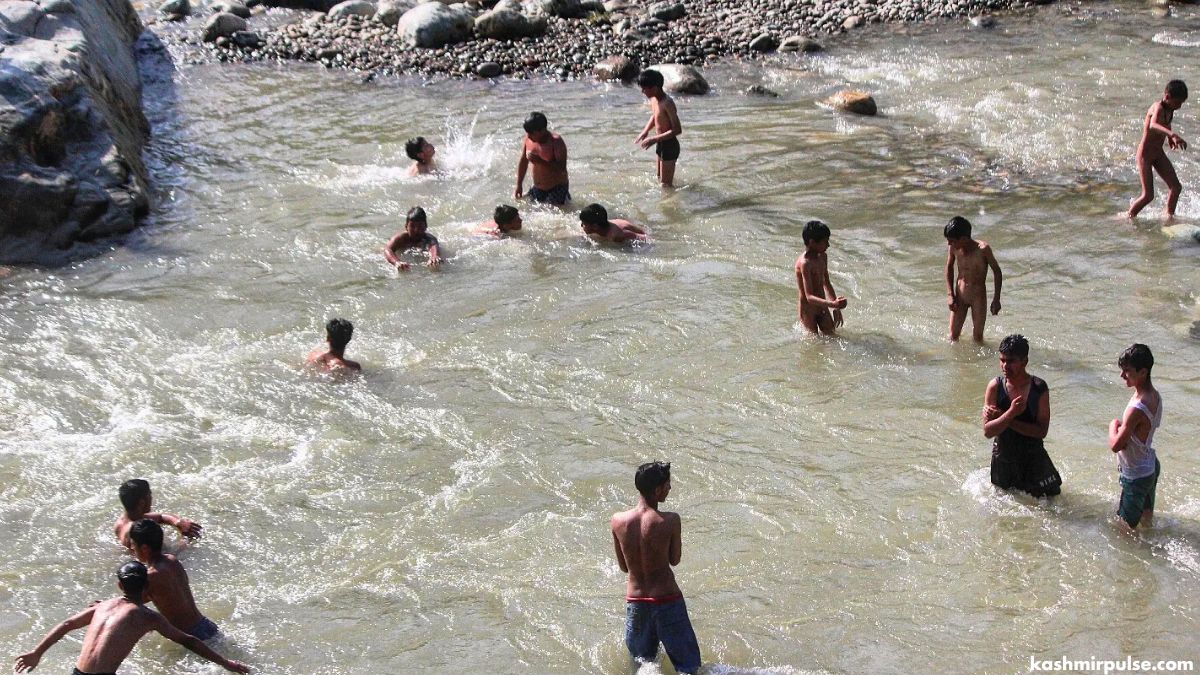
BARAMULLA — An 18-year-old boy, Moin Ahmad Lone, lost his life on Tuesday at the Namblan waterfall in north Kashmir's Baramulla district.

Moin, son of Ghulam Hassan Lone from Heevan Sheeri Baramulla, drowned while visiting the waterfall to escape the persistent heatwave affecting the Valley.

Kashmir has been experiencing a scorching heatwave, prompting residents, particularly youngsters and children, to seek relief in local water bodies such as waterfalls.

Details of the incident remain unclear, with authorities still investigating the exact circumstances that led to Moin's death.

This post first appeared on The Kashmir Pulse

SRINAGAR — The Directorate of School Education Kashmir (DSEK) on Tuesday announced a revised school timing schedule to mitigate the effects of the ongoing heatwave in the Valley.

Starting Tuesday, July 23, and continuing until August 10, all government and private schools in Kashmir up to the higher secondary level will function from 8:00 am to 1:00 pm. Teaching and non-teaching staff will report for duty from 8:00 am to 2:00 pm.

The order from DSEK comes amid numerous appeals from parents and other stakeholders expressing concerns about the impact of the extreme heatwave on students.

Pertinently, weather forecasts indicate that the region will continue to experience high temperatures in the coming days.

This post first appeared on The Kashmir Pulse

SRINAGAR — Kashmir is expected to experience a mix of sunny and cloudy conditions with intermittent rain showers over the next few days, according to a weather forecast issued Tuesday by independent weather forecaster Kashmir Weather.

Temperatures across the region are expected to improve, with a slight chance of rain in the morning or late afternoon in Kashmir. The Jammu region is forecast to see a pause in rain by Tuesday night, with overnight showers possible for the next two days.

The weather service warned of a moderate risk of landslides and shooting stones on the Jammu-Srinagar National Highway.

For pilgrims undertaking the Amarnath Yatra, the forecast predicts a mix of clouds and sun with a possibility of rain showers, but overall dry weather. Temperatures at the holy cave are expected to peak around 20 degrees Celsius and drop to 10 degrees Celsius at night.

This post first appeared on The Kashmir Pulse

SRINAGAR — With the persistent heatwave in Kashmir, teachers and parents on Monday urged the School Education Department to either adjust school timings or announce an additional summer break.

Speaking to the news agency KNO, General Secretary of Jammu and Kashmir Teacher Association (JKTA) Hatim Qayoom said the persistent heatwave is affecting the studies badly and the concerned should consider the change in school timing in both rural and urban areas.

“Due to the extremely hot weather conditions, nowadays, students in schools are feeling low mostly from afternoon onwards. This is affecting their studies badly,” Qayoom said.

He requested the concerned authorities to take appropriate measures in this regard.

Meanwhile, a delegation of various fronts visited the Directorate of School Education Kashmir (DSEK) in this regard.

Parents of the students have also urged the government either to change the timing of schools or extend the summer break.

One of the parents of a student, Manzoor Ahmad said the current weather conditions in Kashmir were not favourable for the students to attend the classes. He, however, said that schooling is also important for students. “The government should either announce further summer vacations or change the timing of schools immediately," he said.

Another parent said he has decided to keep his son back at home till the weather situation improves. “Nothing is more important than the health of my son. I can bear this loss but I can’t compromise the health of my child,” he said.

Pertinently, Kashmir Valley is reeling under an intense heatwave and the MeT department has informed that the situation will almost remain the same for at least a week.

Director of School Education Kashmir Tassaduq Hussain Mir was not available for their comments.

Meanwhile, top officials of the School Education Department said that they were assessing the situation in this regard. “We will seek suggestions from the concerned stakeholders and will take a call accordingly,” the official said.

Earlier on June 30, the School Education Department announced summer break for all schools falling in winter zones from July 08 to 17.

This post first appeared on The Kashmir Pulse

SRINAGAR — As temperatures soared across Jammu and Kashmir in the last few weeks, health officials have advised people to take precautions and stay hydrated.

Speaking with the news agency KNO, health officials advised drinking plenty of water and avoiding aerated drinks to combat the heat.

Dr Mohammad Salim Khan, Head Department of Social and Preventive Medicine, Government Medical College (GMC) Srinagar, said there are unprecedented high temperatures. He provided basic safety tips, recommending consuming plenty of water, electrolytes (ORS), lassi, lemonades and homemade fresh juices. The doctor advised against aerated drinks, juice packs, excessive tea and coffee.

"It is essential to stay indoors during peak heat hours unless absolutely necessary, and to consume 1-3 litres more water/fluids than usual, depending on indoor or outdoor activities," he said. “People should avoid direct sun exposure, especially between noon and 3:00 pm. There is a risk of getting heat strokes, dehydration, and delirium,” he said.

Dr Khan suggested preferring ORS solutions, lassi, chaach (buttermilk), and soups to compensate for water and mineral losses. Tea, coffee, and carbonated drinks should be avoided as they increase urination. Sugary drinks and juices should be avoided due to increased caloric intake, he added.

The doctor recommended wearing light-coloured, loose clothing instead of dark, tight clothes, using scarves, caps or umbrellas to cover the body and applying sunscreen to prevent UV ray damage and skin tanning.

Dr Khan advised against undertaking tiring activities outside in the afternoon and allowing children to participate in sports activities to avoid complications.

According to the doctor, the elderly, young children, pregnant women, those with pre-existing medical conditions, and outdoor workers are at higher risk of complications due to the heatwave.

“They should immediately be moved to cooler locations, and dressed in minimal clothing. Sponging them with cold water, applying ice packs wrapped in cloth, and transporting them to the closest health facility are the best options,” he said.

Advisor for Communicable Diseases at the Indian Council of Medical Research (ICMR), Dr Manzoor, said that rain and heatwaves can give rise to waterborne diseases if drinking water is contaminated or dirty. “Contaminated water can cause many types of diarrheal diseases, including cholera and other serious illnesses, like typhoid and dysentery,” he said.

He advised that people must take filtered and boiled water to remove the bacteria and pathogens that contaminate water to decrease the incidence of waterborne diseases.

Dr Tariq, a general physician, advised that anyone experiencing symptoms such as exhaustion, laziness, weakness, nausea, vomiting, headache, dizziness, mental clouding or disorientation should visit a nearby health facility immediately. "As climate change continues to drive up temperatures, it is essential for everyone to take precautions to stay safe in the heat," he said.

Doctors also advised limiting physical activities, keeping a check on vulnerable individuals and knowing the signs of heat-related illness. They explained that heatstroke can occur when the body's temperature regulation system is overwhelmed by high heat and humidity, leading to a rapid rise in body temperature.

This post first appeared on The Kashmir Pulse

SRINAGAR — A series of thundershowers are forecasted for parts of Jammu and Kashmir over the next week, with the weather predominantly affecting the Kashmir Valley.

On June 15, afternoon and evening thundershowers are expected in Kashmir. This pattern will continue with short thundershowers in some areas of northern Kashmir on June 16, and widespread thundershowers anticipated on June 17 and 18.

From June 19 to 21, short spells of rain are likely in many areas across the region, although continuous rainfall is not expected, and the weather should remain mostly dry.

Meanwhile, a heatwave is predicted in Jammu over the next three days, with temperatures soaring significantly.

Orchard spraying is recommended for early morning on June 16 for optimal conditions.

This post first appeared on The Kashmir Pulse

SRINAGAR — The Jal Shakti Department on Tuesday issued a stern warning to people with illegal water connections, asking them to regularize their connections within a stipulated period of 10 days or face action.

Chief Engineer, Jal Shakti Kashmir, Vivek Kohli, while talking to the news agency KNO, said that the challenge for the department amid the ongoing intense heatwave is to provide drinking water to every household.

He assured that the department is ready to face any forthcoming challenges that may emerge due to the surging temperatures in the valley. He added that providing drinking water to far-off hamlets is a priority for the department, and fleet tankers have been pressed into service for this purpose.

The Chief Engineer stated that the department is scheduling water supplies properly to ensure that no household faces any scarcity of drinking water. "People need to understand that it is drinking water being supplied for drinking purposes. They should not irrigate lawns or wash vehicles with this water. This causes huge wastage and leads to scarcity. We are urging people to use the water judiciously," Kohli said.

Providing further details, Chief Engineer Jal Shakti Kashmir said that the department requires 76 MGD (million gallons per day) but faces a shortage of six MGDs, supplying only 70 million gallons per day.

"This is because people do not use water judiciously. They make ruthless use of water in kitchen gardens and lawns. This is wrong and must be avoided, particularly in these two to three months when the requirement surpasses the supplies. At the same time, I urge people with illegal water connections to get those connections regularized within 10 days or face action," said the Chief Engineer.

This post first appeared on The Kashmir Pulse

SRINAGAR — Amid the heat wave, the Directorate of School Education Jammu (DSEJ) on Tuesday ordered summer vacation for all government and private schools from June 1 to July 16 in summer zone areas of the region.

According to the news agency KNO, DSEJ in an order said, “All the government and recognised private schools falling in summer zone of Jammu Division shall observe summer vacation from 01-06-2024 to 16-07-2024.”

The directorate further ordered that all teachers shall remain available for any online guidance of students during the vacation period.

“Any default on the part of the head of the school or teaching staff in observance of the above schedule shall attract action under rules,” DSEJ said.

This post first appeared on The Kashmir Pulse

SRINAGAR — The Meteorological Centre in Srinagar has issued a weather forecast for Jammu and Kashmir, predicting generally dry conditions with intermittent chances of thundershowers at isolated locations.

From May 28 to 29, generally dry weather is expected, though thundershowers may occur in isolated areas. On May 30 and 31, the region will experience partly to generally cloudy conditions with light rain or thunderstorms at isolated places. This pattern will continue from June 1 to 2.

A return to generally dry weather is forecast for June 3 to 5, followed by generally cloudy conditions with light rain or thunderstorms at isolated places from June 6 to 7.

The heatwave and hot, dry weather will persist over the plains of the Jammu Division for the next seven days. However, slight relief from the heatwave is expected from May 30 to June 2 in most parts of the Kashmir Division and some hilly areas of the Jammu Division.

It is in place to mention here that another spell of the heatwave is anticipated from June 3 to 5.

Residents are advised to avoid heat exposure between noon and 3 pm and to drink plenty of fluids, particularly vulnerable individuals such as the elderly, infants, and children.

This post first appeared on The Kashmir Pulse
Powered by Blogger.