SRINAGAR — Facebook, Instagram, Threads and Messenger, the platforms managed by Meta, have reported a global outage, outage tracking websites Downdetector said.

Users were unable to load apps, deliver messages and refresh their search feeds on Facebook and Instagram. There were more than 300,000 reports of outages on Facebook, while there were more than 20,000 reports on Instagram, according to the website.

Downdetector tracks outages by collating status reports from a number of sources including user-submitted errors on its platform. The outage could have affected a larger number of users.

Meta has not responded to the global outage and it's unclear how much time will the servers take to resume functions.

WhatsApp, which is also owned by Meta, has not reported any outages yet. Though newly launched X rival Threads is down too. With minutes of outage, people moved to Elon Musk-owned X and #Instagramdown, Facebook and Mark Zuckerberg are trending on the social media platform, with users sharing memes over the global server issue.

Last year, a major outage was reported in July across Meta platforms including WhatsApp. The services were restored later in the day. The outage in July came weeks after a similar issue was reported in June.

This post first appeared on The Kashmir Pulse

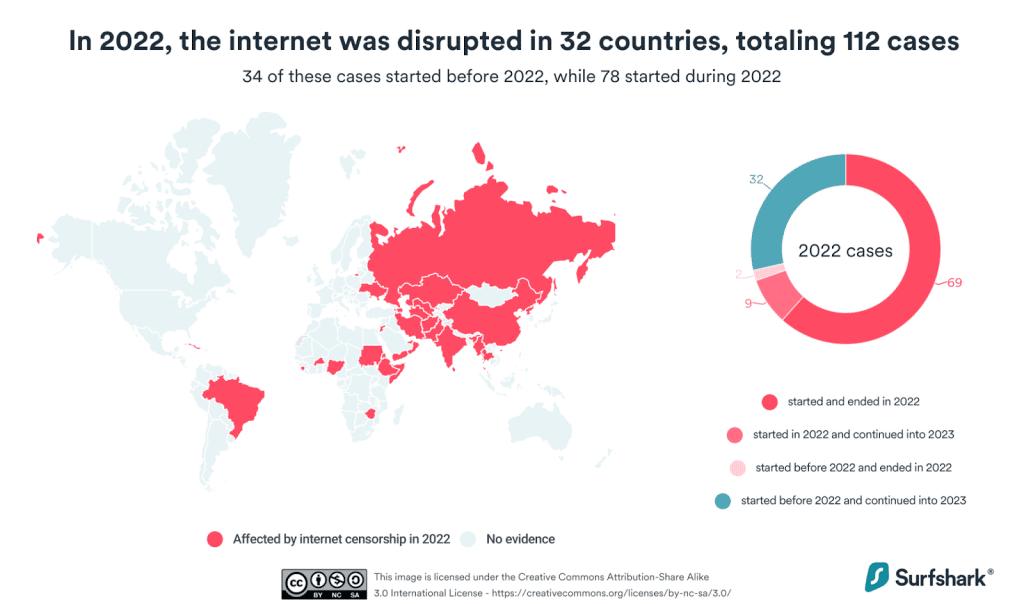
NEW DELHI — Surfshark’s internet censorship yearly recap shows that 4.2 billion people were affected by internet censorship in 2022 globally, while Asia accounts for nearly half (47%) of all new cases in 2022. The Jammu and Kashmir region took the lead by case count, with 24 recorded internet disruptions. 10 additional cases were recorded across the rest of India.

"Internet censorship remains a common technique used by autocratic governments to isolate their citizens from the outside world," a press statement issued by Surfshark said.

Surfshark spokeswoman Gabriele Racaityte-Krasauske added, “More than half of the world’s population was affected by internet censorship last year. Many of these cases involved full internet disruptions on a local or national level. These can be devastating and extremely dangerous, especially during wartime, protests, or violent government repressions. Internet restrictions can make it difficult or even impossible to mobilize people for the defense of democracy, contact loved ones, access news sites, and spread information to the outside world on what’s happening.”

Overview of internet ban in 2022, globally
Graphical representation of internet bans in 2022, globally

"Through the past year, we’ve seen how governments have used internet shutdowns and telecommunications blackouts as a tool of repression and control, silencing journalists, civil society, and the general public. Internet connectivity today underpins all human rights, which is why it’s more critical than ever to document mass-censorship incidents and find ways to get people reconnected," Alp Toker, Director, NetBlocks, opines.

Asia continues to lead by internet disruption count

11 Asian countries imposed new internet disruptions in 2022, bringing a total of 58 cases. The Jammu and Kashmir region has the highest disruption count in the world (24), followed by Iran (11) and the rest of India (10).

Africa follows Asia as the second most disruption-intensive region, with 5 countries imposing 13 restrictions. Sudan takes the lead in Africa by disruption count (4), followed by Burkina Faso (3) and Zimbabwe (3).

Here are a few of the most worrisome internet censorship events in Asia in 2022:

  • June - India disrupts internet access amid military recruitment protests.
  • September - Mass-scale internet disruptions in Iran in the wake of Mahsa Amini’s death.
  • Jammu and Kashmir region accounted for 24 new disruption cases in 2022 - more cases than any country in the world.

Burkina Faso, Russia, and Azerbaijan had the longest internet disruptions last year

  • Burkina Faso restricted Facebook in January. The restriction continued into 2023.
  • Russia’s Twitter, Facebook and Instagram disruptions following the invasion of Ukraine are still ongoing. The country has also blocked access to major international news sites.
  • Azerbaijan restricted TikTok in September. The platform remains restricted to this day.

Of all social media platforms, Facebook is the most hated by autocratic governments and remains highly censored in 2022. In fact, since 2015, a staggering 46% of the global population has, in some way or another, been affected by government-imposed Facebook restrictions.

The Internet Censorship Tracker was developed by Surfshark in partnership with internet watchdog NetBlocks. The research tracks partial and complete internet and social media shutdowns in 196 countries and territories from 2015 onwards.

Here are the key takeaways:

⊝ 4.2 billion people were affected by internet censorship in 2022 globally.
⊝
Asia accounts for nearly half (47%) of all new cases in 2022, which is more than any other continent.
⊝
The Jammu & Kashmir region had the highest number of restrictions (24) - this is more than any country in the world.
⊝
The main causes of internet censorship in 2022 were protests and political turmoil.
⊝
Facebook was the most-restricted social media platform in 2022.
This post first appeared on The Kashmir Pulse

SRINAGAR — Non-professional journalists have been earning a bad name to Kashmir journalism every now and then. The mushroom growth of Facebook journalists, who are good at the noise, end up creating a people-friendly image for themselves at the cost of maligning image of professionals.

From a simple protest at the Press Colony to any law and order issue, these Facebook journalists (as they are called in local lingo) are always omnipresent. Even they can be seen in the press conferences, which are sometimes reserved. Unabashed and uncouth, most Facebook journos are semi-literate small-time go-betweens who try to earn quick bucks using journalism as a stepping stone.

A cursory study of these random journalists, who mostly camp on roads and pavements at the Press Enclave, reveals that most of them are operating Pages on Facebook. They have fancy names and post videos and happenings on their Pages.

Apart from poor content production, these Facebook reporters are increasingly resorting to emotive calls through their repetitive sob-stories on poor families. Some of the “incorrigible offenders” have already become self-styled cults, thriving on their cabal and coterie.

The Facebook journalists would publish emotionally-charged videos on their Facebook Pages and other social media accounts and collect funds for the poor families. But one such fundraising campaign has landed a few such Facebook journalists in the trouble.

There’s nothing wrong in pleading the cases of poor families, but the manner in which it is being done has become a medium business in Kashmir now. A case has come into the notice of this media-house where these self-styled reporters have misused the video of one of the families in Srinagar.

As per the sources, a destitute family was seeking financial help from the general public in February. Keeping the generosity of Kashmir alive, the family received a sufficient amount and accordingly, the case was closed. But after two months, the same video was again uploaded by these Facebook reporters but with a different account number. The family filed a complaint against the portal for “misuing” content for their personal benefits.

Accordingly, we tried to get the details of the case from the Police Station Safa Kadal. However, SHO asked us to get the details from station. “I cannot provide details of the case on phone. You can personally visit my office and collect the same,” he added.

A senior journalist from Srinagar said that these social media reporters are not accountable to anyone for their wrongdoings. The onus lies on the government to tackle these “Facebook journalists” giving a bad name to journalism.

“This sentimental and social media driven journalism is unfortunately wooing masses in Kashmir and has widened the gap, with people losing trust on the professional media houses,” he added.

The administration should find a way out of getting these portals registered so that the charity will reach needy people instead of these “thugs” who have left no stone unturned in ruining ethics of journalism by playing with the people's emotions.

It’s the need of the hour for media fraternity in the valley to make one voice to move forward and get united under one umbrella and fight against these “social-media journalists”.

“If anyone among the journalist community commits a crime, the entire fraternity is held responsible for it,” said a senior editor in the backdrop of the recent incident in which three media-affiliated persons were arrested for extortion in Kupwara.

“Although this phenomenon is not confined to Kashmir only, the government needs to keep a tab on it and should check the authenticity of these Facebook Pages before trusting them,” he added.

Pertinently, last year two renowned 'Facebook journalists' were arrested under FIR No. 145/2021 under Sections 384 (extortion), 385 (putting a person in fear of injury in order to commit extortion), 506 (punishment for criminal intimidation), 420 (cheating and dishonestly) and 120B of the IPC.

This post first appeared on The Kashmir Pulse
Powered by Blogger.