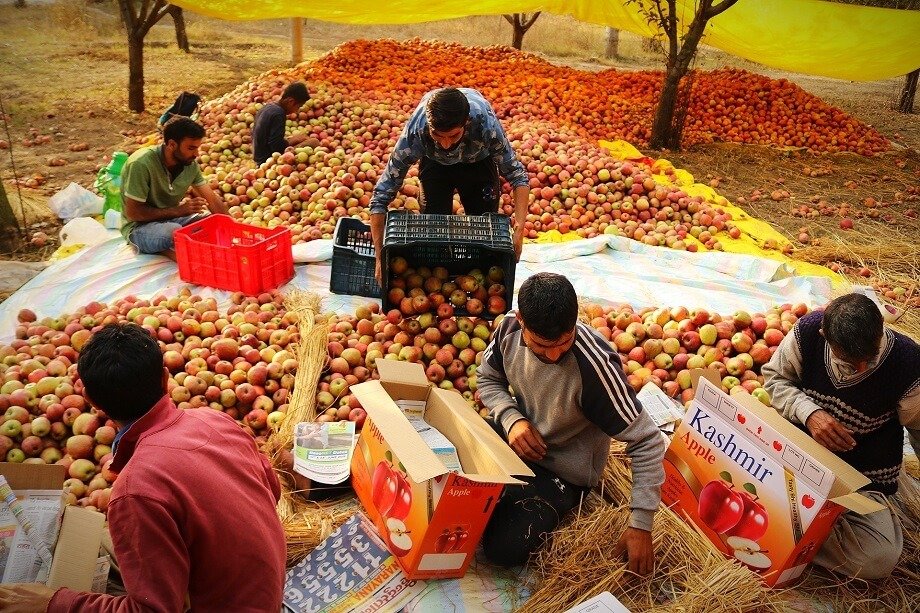
PULWAMA — The fruit growers and traders in Kashmir who had kept their produce in cold storage units said they are facing huge losses as rates have plummeted to an all-time low.

Speaking to the news agency KNO, the growers and traders said they have been facing huge losses as rates have been going down with each passing day. They said currently apple boxes are being sold at Rs 300-400 per box while the rates of C-grade apples in the main season were more than that.

Mudasir Ahmad, a fruit trader, said that he had purchased around 10 thousand apple crates at around Rs 1000-1500 per crate and kept them in cold storage units in Lassipora Pulwama. He said currently his apple crates are fetching just around Rs 300-400 only due to which he faces a loss of Rs 1000-1200 per crate which is around one crore rupees of loss.

"I have been doing fruit business for the last 10 years but have earned just a few lakhs in the last 10 years as I have been facing a loss in crores which has left me and my family in depression," Mudasir said, adding that same is the case of other fruit traders who have purchased and kept their produce in CA stores.

Traders said they stopped packing their produce for some time but are aware that they can't keep it there for a long time. "Six to seven months have already passed since we kept it there," they said.

"Even the C-grade apples fetched more returns in the main season and this is an all-time low rate of produce kept in cold storage units," they said. "This is because apples in bulk quantity have been reaching Indian markets from different countries, thereby denting local apples."

Meanwhile, cold unit holders sought the government's intervention under these conditions. "Otherwise, this may have a negative impact on cold storage units," they said.

Anjum Abrar, a manager of one such unit, said there is a positive impact of cold storage units that they maintain the supply and demand chain, which benefits growers by ensuring favourable returns. "If the produce kept in cold storage units won't fetch good returns, then how will people prefer to keep their produce in CA stores?" he asked.

"The government must intervene in stopping the import of apples so that Kashmiri growers and traders fetch good returns," Abrar said.

He said that the cold storage units have been employing thousands of people. "Neglecting this sector would impact the livelihoods of thousands of workers," he said.

This post first appeared on The Kashmir Pulse


SRINAGAR — With Ramadan in progress, demand for Kashmiri apples has soared across India. Since the beginning of Ramadan, growers have started shipping apples, which were stored in cold storages, to the rest of India.

As per the growers, the apples currently have a good demand across India as the holy month of Ramadan is in progress.

“CA-stored apples have a good demand right now. Right now Kashmiri apples are being shipped to the leading fruit markets of India. We still have a huge quantity of apples still stored in cold chain facilities ready to be shipped to the various markets of India,” President North Kashmir Fruit Growers and Dealers Association, Fayaz Ahmad Malik, told the news agency KNO.

With Ramadan being a time of increased consumption of fruits and other nutritious foods, Kashmiri apples have become a staple on Iftar tables in many households. According to reports, the demand for Kashmiri apples has soared in major cities like Delhi, Mumbai, Kolkata, and Bengaluru.

Apple growers said the rate of apples ranges between Rs 1500-1600 in various fruit markets in India. “CA-stored apples get a good price since they become available in various cities of India during the off-season. Right now, an apple box costs from Rs 1500-1600,” Malik said.

Apple growers said Ramadan often proves to be a lucrative season for Kashmiri apples given their demand in various cities of India.

“During the current season, only Kashmiri apples become available in the markets of India. So, growers ship a bulk quantity of apples to various fruit markets. The CA-stored apples will hit markets for the next three months,” said Shabir Ahmad Khan, an apple grower who too has preferred to ship his CA-stored apples to New Delhi’s Azadpur Fruit Mandi during Ramadan.

CA stores have come as a shot in the arm for apple growers of Kashmir, who get good returns of the crop during the off-season. As per the apple growers, all the CA stores were occupied at full capacity as the rates of apples this season have been comparatively better.

This post first appeared on The Kashmir Pulse
SRINAGAR — The Kashmir Valley has witnessed a 50% decrease in watermelon sales following concerns raised on social media regarding the safety of consuming artificially ripened watermelons.

Dr Wajahat, a clinical oncologist at a premier hospital, recently cautioned against consuming artificially ripened watermelons during the off-season, citing potential cancer risks.

"This Ramzan, say NO to artificially ripened watermelons. Protect yourself from harmful chemicals and potential chemotherapy," Dr Wajahat posted on a social media site X on March 8, which garnered support from several other doctors.

Ghulam Nabi Bhat, a vendor, expressed concern over economic losses incurred since the beginning of Ramadan. He said that despite bringing watermelons to the market, nobody is buying them due to claims made by doctors. Bhat urged the government to investigate the matter to help vendors like him avoid further economic losses.

Bashir Ahmad Bashir, chairman of the Kashmir Valley Fruit Growers Cum Dealers Union, while speaking with the news agency KNO, said there has been a 50% drop in watermelon sales in the valley due to the current situation. "Previously, the valley used to receive 12 trucks of watermelons daily, but now there has been a 50% decrease in sales,” he said.

Bashir said the Food Safety Department has taken samples of watermelons, and he hopes for clarity soon. “Health is a priority, but economic losses are also concerning. The government should share the test samples as soon as possible,” he added.

Deputy Commissioner of Food Safety in Kashmir, Shagufta Jalal, said the department has collected hundreds of samples from various districts of the valley for testing. “The test reports will be available tomorrow,” she said.

Once the report is available, it will be shared with the public to address any concerns, Shagufta said, adding that there have been no adverse findings so far in the surveillance sampling.

This post first appeared on The Kashmir Pulse
SRINAGAR — In a groundbreaking development, the Jammu and Kashmir Government has achieved unprecedented success in its recent auction of liquor shops, with revenues surging to an all-time high of Rs 2280 crore in the fiscal year 2024.

This substantial increase in revenue, as per the official reports, compared to previous years, underscores the efficacy of the state's revamped excise policy, which was implemented three years ago to streamline the auction process and enhance revenue generation.

As per the reports received by the news agency KNO, the auction witnessed fierce bidding wars, culminating in the sale of a liquor shop in Qazigund, Kashmir, for an astounding Rs 5.23 crore.

This historic bid not only marks the highest ever recorded in the erstwhile state but also highlights the growing investment interest in the region's liquor industry. Similarly, a shop in Ramnagar, Udhampur, fetched a commendable Rs 3.41 crore.

"The overwhelming response to the auction demonstrates the buoyancy of the market and the potential for further revenue generation," says an official, adding that we are committed to fostering a conducive business environment and ensuring transparency in the auction process."

The success story of the auction is further underscored by the steady growth in excise revenue over the past few years. In 2020, the department recorded earnings of Rs 1320 crore, followed by Rs 1353 crore in 2021, Rs 1777 crore in 2022, and Rs 1796 crore in 2023, culminating in the historic milestone of Rs 2280 crore in 2024.

Looking ahead, officials anticipate continued financial growth, with 38 liquor shops yet to be auctioned. "We remain optimistic about the prospects for revenue generation in the coming years. With prudent policies and effective management, we aim to maximize revenue streams and contribute to the socio-economic development of Jammu and Kashmir," reports quoting government sources said.

Reports inform that the significant increase in excise revenue is poised to bolster the government's fiscal capabilities, enabling it to invest in critical infrastructure projects, social welfare programs, and other initiatives aimed at enhancing the quality of life for the people of Jammu and Kashmir. As the auction process continues to unfold, stakeholders express optimism for sustained economic prosperity and stability in the region.

This post first appeared on The Kashmir Pulse

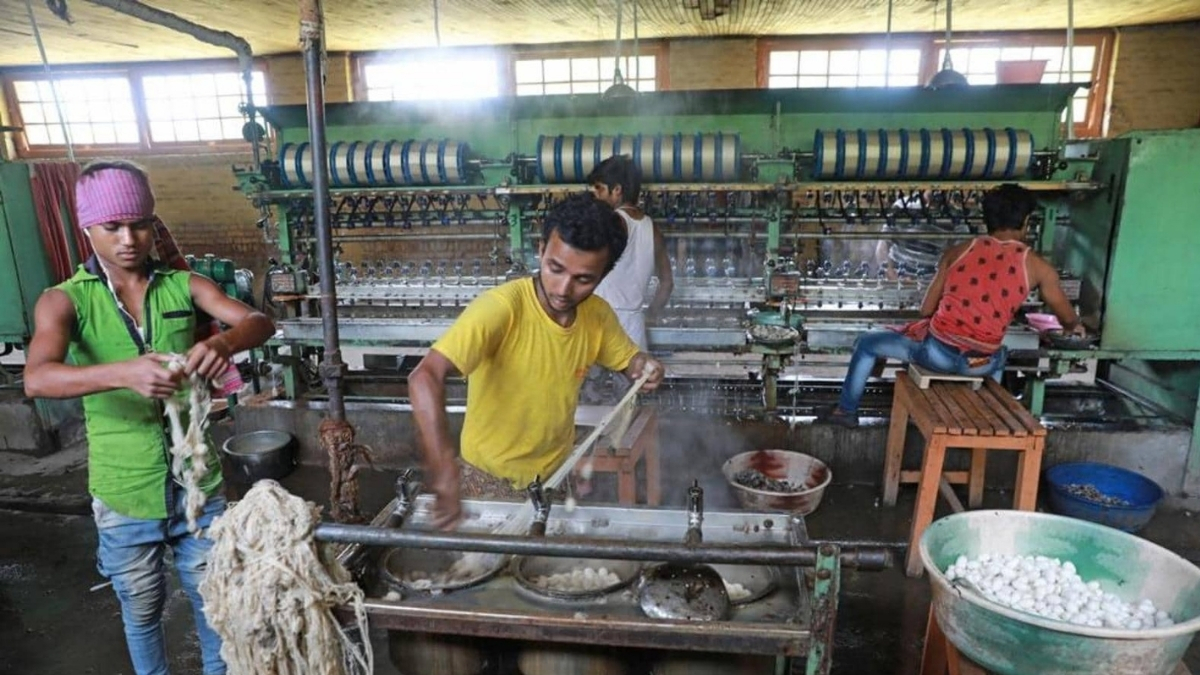
SRINAGAR — The World Bank funding has played a crucial role in the revival of Kashmir's eight-decades-old silk factory, as the introduction of new technology and high-tech looms funded by the bank has increased eightfold in the past years, an official said.

The silk fabric production at Srinagar's government-run 86-year-old Rajbagh silk factory has increased by almost three times, with the involvement of better machines and equipment, Syed Zameer, the manager of the silk factory, informed the news agency KNO.

"The Rajbagh silk factory was established in the year 1937, and at that time, we had different machines and looms available here," he said.

Zameer said after the 2014 flood, the machines and equipment here became non-functional. Under the Jhelum Tawi Flood Recovery Project (JTFRP), financed by the World Bank, efforts were made not only to restore heritage buildings but also to support the livelihoods of those affected, including the revitalization of the silk industry, he said.

The project, the manager said, aimed to maintain the livelihood of people affected by the floods and also restore Jammu and Kashmir’s heritage buildings. "The funding also helped us to increase our production, and presently we can manufacture more products than in the past," he said.

"We can manufacture 1.5 lakh metres of silk in a single shift and 4.5 lakh metres if we work in three shifts,” he said, adding that before the JTFRP project, they had only seven to eight varieties of silk available, but currently, the factory manufactures thirty varieties of silk.

"We have also increased and enhanced the quality by almost three times," he said and added that the sales have increased by about five times, and now, they have tie-ups with many parties from outside Jammu & Kashmir who are purchasing the silk-made products.

The equipment including TFOs, winding machines, TLC-based looms and warping machines helped us further increase our production, he added.

The modernization and the upgradation of the government silk weaving factory, Rajbagh, was done in the year 2021 and was inaugurated by Lieutenant Governor Manoj Sinha.

This post first appeared on The Kashmir Pulse

JAMMU — The Administrative Council (AC), which met here under the chairmanship of Lieutenant Governor, Manoj Sinha, approved a proposal of the Finance Department for granting amnesty for the settlement of Tax arrears about pre-GST regime.

Rajeev Rai Bhatnagar, Advisor to the Lieutenant Governor; Atal Dulloo, Chief Secretary; Mandeep Kumar Bhandari, Principal Secretary to the Lieutenant Governor attended the meeting.

This step is going to provide relief to the tax-payers in the form of waiver of interest and penalty besides recovery of the blocked revenue to the government.

Earlier, all dealers could not take benefit of the erstwhile amnesty scheme issued vide Government Order No. 39-FD of 2018; Dated 05-02-2018 due to various reasons including the COVID-19 pandemic.

As such, a large number of representations were received from the trade/industry sector for granting a one-time opportunity to the dealers for settlement of the outstanding arrears under the pre-GST tax legislation. The amnesty scheme provides relief to dealers on:

i) 100% waiver of penalty and interest under J&K General Sales Tax Act, 1962, and Central Sales Tax Act, 1956, for assessment/re-assessment up to 2017-18 (07-07-2017 for all and 31-08-2017 for liquor dealers);

ii) 100% waiver of penalty and interest under J&K Value Added Tax Act, 2005, and Central Sales Tax Act, 1956, for assessments up to 2017-18 (07-07-2017);

iii) Waiver of interest and penalty in (i) and (ii) subject to 100% payment of principal tax in the manner and within the prescribed time as per the scheme to be notified by the Government;

iv) Settlement of demands for Industrial Units under repealed J&K Value Added Tax Act, 2005 (up to 2017-18) (upto 07-07-2017), J&K General Sales Tax Act, 1962 (up to 07-07-2017 and 31-08-2017 for liquor-dealing units), and Central Sales Tax Act, 1956, in respect of assessed/re-assessed demands including yet to be assessed cases with certain conditions to be notified in the scheme.

This decision on the part of the government will result in minimising tax dispute cases and winding up pre-GST cases etc. The time limit for receiving the applications for this amnesty will not be more than six months from the date an order is issued in this regard.

This post first appeared on The Kashmir Pulse

In the dynamic world of financial management, a personal loan for salaried individuals often emerges as a beacon of hope during times of financial crunches. For countless salaried professionals, unexpected expenses can be a daunting reality. Whether it's a medical emergency, an unforeseen travel need, or pursuing higher education, financial constraints can appear unannounced.

Here, a personal loan for a salaried person comes to the rescue, offering a lifeline to bridge the financial gap seamlessly. Not only does it provide the advantage of competitive interest rates, but it also offers the flexibility to repay in structured installments. With hassle-free documentation and speedy approval processes, acquiring an instant personal loan for salaried professionals can indeed be a financial game-changer.

In this blog, we will delve deeper into the merits of personal loans for salaried employees and understand how these can act as a pivotal tool in reshaping the fiscal landscape for salaried individuals.

Advantages of personal loan for salaried employees

1. Bridge the immediate financial gaps

Life can spring surprises on us - be it a medical emergency, sudden home repairs, or an unexpected travel requirement. In these instances, digging into long-term savings or investments might not be the most feasible option. A personal loan for salaried online can offer immediate financial respite, ensuring that you don't need to compromise your savings.

2. Debt consolidation

Juggling multiple debts? A personal loan for salaried employees can serve as a tool for debt consolidation. Instead of managing multiple EMIs with varying interest rates, you can combine all your existing debts under one umbrella. This not only simplifies the repayment process but often comes with a lower interest rate, saving money in the long run.

3. Fueling life milestones

Be it a dream wedding, an advanced education degree, or a home renovation project, fulfilling life’s significant milestones often comes with a price tag. A personal loan for salaried individuals makes these dreams attainable without derailing one’s financial journey.

4. Enhancing credit score

Taking a personal loan for salaried professionals can enhance one's credit score. When you borrow and repay responsibly, it portrays you as a trustworthy borrower, positively impacting your credit score. This can be especially beneficial for those looking to build or repair their credit history.

5. Flexible and straightforward

One of the significant advantages of a personal loan for salaried employees is its flexibility. Unlike specific loans, like car loans or home loans, you can use salary personal loans for any purpose. Additionally, the application and approval process is often swift, ensuring funds are available when you need them the most.

6. Competitive interest rates

With the proliferation of financial institutions offering instant personal loans online for salaried professionals, the competition has intensified. As a result, many banks and NBFCs are offering loans at competitive interest rates. With proper research, employees can secure an instant loan for salaried employees loan at a rate that doesn't break the bank.

7. Structured repayment plans

A personal loan for salaried individuals often comes with a clear, structured repayment plan. You have the flexibility to choose the loan tenure, which allows you to plan your monthly outflow effectively. This clarity ensures that there are no surprises along the repayment journey.

8. No need for collateral

Most personal loans for salaried professionals are unsecured. This means you don’t have to pledge any asset or collateral to secure the loan. For employees who might not own significant assets or are wary of pledging them, this is a huge advantage.

9. Financial freedom and autonomy

The beauty of a personal loan for salaried employees is the financial autonomy it offers. You are not answerable to anyone regarding the usage of the funds. This freedom ensures you can utilise the funds where they are most needed without any external constraints.

10. Can be a cushion for investments

For those who understand the nuances of investments, a personal loan for salaried individuals can act as a cushion. For example, if you spot a short-term investment opportunity that promises higher returns than the loan's interest, borrowing can indeed be a smart financial move.

Parting thoughts

A personal loan for salaried individuals stands as a versatile and reliable financial ally in today’s ever-evolving financial landscape. One noteworthy platform facilitating this transformative journey is KreditBee. With a commitment to ensuring accessibility and convenience, KreditBee offers a streamlined process for acquiring a personal loan for salaried employees, making it easier than ever to handle unforeseen expenses.

In navigating the myriad financial waters, a personal loan for salaried employees, especially with trusted partners like KreditBee, can indeed be the beacon leading to financial solace and empowerment. As financial uncertainties remain ubiquitous, this unique financial solution emerges as a cornerstone, enabling a journey of resilience and prosperity and further solidifying its indispensable role in the financial arsenal of salaried employees.

This post first appeared on The Kashmir Pulse

SRINAGAR — The Jammu & Kashmir Government will not regulate the prices of mutton in the Union Territory from now onwards.

The Department of Food, Civil Supplies and Consumer Affairs of J&K Government on Tuesday directed the Directorates of Food, Civil Supplies & Consumer Affairs, Jammu/Srinagar, all district administrations and other enforcement agencies, who are regulating prices of livestock products, to refrain from issuing any order on regulating prices of mutton.

The government decided against regulating the prices of mutton after the Centre communicated to it that the notification under which the powers were delegated to Jammu & Kashmir Government for regulating certain commodities is no longer valid.

“…..the Ministry of Consumer Affairs, Food and Public Distribution, GOI vide its communication No. S-15/1/2023-ECR&E, dated 20.04.2023 clarified that any order issued by quoting S.O 145(E) dated 15.02.1990 is based on an order that is no longer valid and applicable, as such, the Ministry advised the Food Civil Supplies & Consumer Affairs Department, J&K to issue necessary directions to all concerned authorities to refrain from issuing or enforcing any order quoting S.O. 145(E) dated 15.02.1990,” the notification states, as per the news agency KNO.

The Centre issued the clarification after the J&K’s Agriculture Production Department asked it whether the notification under which the powers were delegated to the Government of Jammu and Kashmir for regulating the commodities specified in the schedule(s) to the said notification was valid.

The J&K Government also repealed 'The Jammu and Kashmir Mutton (Licensing and Control) Order, 1973'. The order provided that “no person shall carry on the business of mutton as a wholesaler, broker or a retailer except under and in accordance with a license issued on this behalf by the Licensing Authority”. The prices of mutton were also regulated under the order.

This post first appeared on The Kashmir Pulse

As employers in the fast-paced, unpredictable environment of the 21st century, it's our responsibility to keep our teams safe. One significant way to do this is by insuring them against the unexpected. Group accident insurance policies can play a pivotal role in modern workplaces, providing financial security and peace of mind for both employers and employees. Let's delve into the importance of these policies and why they are an absolute must-have for contemporary organizations.

Ensuring Employee Well-being: A Fundamental Responsibility

Companies are only as robust as their employees. Therefore, investing in their well-being is not merely a moral duty but also a strategic business decision. In case of an unfortunate accident, the financial strain can be overwhelming for the affected employee and their family. Having an insurance policy in place will cover these unexpected costs and provide much-needed support in challenging times.

Fostering Trust and Loyalty: A Step Towards a Dedicated Workforce

When employees know their employers have taken steps to protect their health and well-being, they are more likely to stay dedicated and loyal to the organization. Therefore, having a group accident insurance policy can contribute significantly towards creating a positive work environment and boosting employee morale.

Attracting and Retaining Talent: The Competitive Edge

In the war for talent, businesses need to offer competitive benefits packages to attract and retain skilled employees. Group accident insurance policies can be a crucial part of these packages, setting your organization apart from others and demonstrating that you genuinely care for your team's welfare.

Enhanced Productivity: A Byproduct of Security

Financial stress can significantly affect an employee's productivity and focus. However, knowing that they and their family are financially protected in the event of an accident can alleviate this stress. Consequently, this sense of security can contribute to increased productivity and job satisfaction, positively impacting the company's bottom line.

Protecting the Company's Interests: A Wise Business Decision

Group accident insurance policies not only protect employees but also the organization. When an accident results in an employee's absence from work, the company may face substantial losses. However, insurance policies can offer compensation, helping to cover these losses and ensure business continuity.

Adapting to Remote Work: A Response to Modern Challenges

With the rise of remote work due to the COVID-19 pandemic, employees are no longer confined to the traditional office environment. They are now working from various locations, each with its unique set of risks. Having a comprehensive group accident insurance policy can provide coverage irrespective of location, ensuring protection for employees in the evolving work scenario.

How to Choose the Right Policy: Essential Factors to Consider

While it's clear that group accident insurance is essential, it's also crucial to select the right policy. Factors like the sum insured, policy terms, claim process, and the insurer's reputation should all be considered. Additionally, keep in mind the nature of your business and associated risks when deciding on the policy.

In a world where uncertainty is the only constant, providing our team with a protective cover against the unexpected is paramount. Group accident insurance policies offer an efficient way to safeguard our employees' interests and ensure a secure work environment. As responsible employers, let's strive to create a safe, secure, and supportive workplace where our team can thrive. Because when our employees prosper, so does our business.

This post first appeared on The Kashmir Pulse


JAMMU — The Jammu and Kashmir Government has sought suggestions on J-K Industrial Land Allotment Policy 2021-30, J-K Private Industrial Estate Development Policy 2021 and the introduction of J-K Logistics Policy.


Pertinently, the government has recently (March 8) initiated the process of amending and upgrading these policies by putting the same in the public domain for review and feedback and seeking suggestions from the public and the stakeholders by March 28, 2023.


The UT government is in the process of making amendments to these policies to attract investment in the UT and making Jammu and Kashmir the most investor-friendly Union Territory.


The policy drafts are available on the official website of the Jammu and Kashmir Industries Department, www.jkindustriescommerce.nic.in, for a period of 21 days. The decision by the department is believed to be another step to onboard its stakeholders.


These policy amendments aim at creating a progressive, innovative and competitive industrial ecosystem, generating employment in the UT while mobilizing investments from across the world.


The policies have been made public to allow the business community, industrialists, investors, trade organizations and other stakeholders to provide feedback.


The Department of Industries and Commerce has already started receiving suggestions from the relevant stakeholders and is looking forward to receiving more comments in the coming days. “All the relevant stakeholders can email their comments and suggestions at principalsecretaryindustryjk@gmail.com.”


This post first appeared on The Kashmir Pulse



SRINAGAR — The demand for traditional winnower, popularly known as 'Shupp', is on the decline due to which winnower makers are struggling to make two ends meet.


The winnower makers in Kashmir claimed that they are going through difficult times as they are finding it very difficult to sell their pieces.


Muhammad Ramzan Sheikh, a resident of Padgampora Awantipora in south Kashmir's Pulwama district, said that he has been associated with this business for the last three decades but this is the most difficult time for them as no there are no customers for the items.


"Earlier, there was good demand for 'Shupp' but with advancement and new technologies, the demand for Kashmiri traditional winnower has declined and there is no demand for it anymore," he said, adding that every year, they used to sell thousands of winnowers but now are making just a few pieces and have to go from village to village to sell these pieces.


“A winnower maker was earning his livelihood very well as earlier winnowers were being used to separate grains from the husk, cleaning rice and other things but with new technologies in the market, machines have been doing this work and winnowers are hardly used anymore,” he said.


Kashmir's traditional rice winnower Shupp making


He said that at present, a winnower maker spends hundreds of rupees to make a 'Shupp' but there are hardly any takers.


Ab Rehman Sheikh, another winnower maker from Awantipora, said that he has spent days together in different villages to find customers but nobody is ready to take them as people hardly need winnower anywhere now.


“We have even taken loans but due to a decline in demand, we are unable to pay loan installments,” they said while adding further that “earlier, we were earning our livelihood very well but now a person hardly earns Rs 100 on a daily basis on which making both ends meet is very difficult.”


He said that they have spent their entire life making 'Shupp' and can't do anything else now which is why they are still associated with the business even as the same is dying slowly.


They said hundreds of households in Awantipora area were associated with winnower making but due to low demand, their number has reduced to just 20-25 now.


This post first appeared on The Kashmir Pulse



SRINAGAR — The government has decided to ban the sale of gold jewellery and gold artifacts hallmarked without a six-digit code from next month.


The Ministry of Consumer Affairs, Food and Public Distribution in a statement said that the decision has been taken to ensure a quality culture in micro sale units. The decision was taken after a review meeting of the Bureau of Indian Standards (BIS), chaired by the Union Commerce and Industry Minister Piyush Goyal, held on March 3, 2023.


The Ministry informed that in an effort to promote quality culture in micro-scale units, BIS is providing an 80 percent concession on the certification/minimum marking fee across various product certification schemes of BIS. It said additionally, units located in the North-East will continue to receive an extra 10 percent concession.


The Union Minister stated that the government is committed to ensuring that all products in India meet the highest quality and safety standards. He said these measures shall promote micro-scale units, enhance the testing infrastructure, and develop a culture of quality consciousness among citizens.


This post first appeared on The Kashmir Pulse

NEW DELHI — Agriculture and Farmers Welfare Minister Narendra Singh Tomar has said that the farmers are getting more money directly in their accounts through the Direct Benefit Transfer scheme.

He said the use of technology has eliminated the middlemen, brought transparency, and benefited the farmers. He said expenditure on Minimum Support Price has increased manifold in recent years which directly benefited the farmers.

Briefing media in New Delhi today, Tomar highlighted the measures taken by the government to ensure food availability, create robust mechanisms for the procurement of foodgrains, and effective implementation of the 'One Nation One Ration' card initiative in the country. The Minister said three lakh 81 thousand crore rupees have reached the accounts of farmers through the DBT scheme.

He said 80 crore people have been provided free foodgrains which helped the poor to deal with the effects of the Covid pandemic. He said three lakh 90 thousand crore rupees have been spent on Pradhan Mantri Garib Kalyan Ann Yojana.

On MSP’s expenditure, Tomar said, one lakh six thousand crore rupees have been spent in 2014-15 which subsequently increased to two lakh 75 thousand crore rupees in 2021-22.

The Minister said more than one lakh 14 thousand crore rupees dues of sugarcane farmers have been cleared out of the total dues of more than one lakh 18 thousand crore rupees for the season 2021-22.

He informed that India has become the largest producer and exporter of sugar. He said the export of sugar has subsequently increased in recent years. He said the total export was 6.8 lakh metric tonnes in 2017-18 which reached 110 lakh metric tonnes in 2021-22.

On the procurement of millets, Tomar said, seven states have made the procurement of 13 lakh tonnes.

This post first appeared on The Kashmir Pulse
SRINAGAR — Jammu Kashmir Hoteliers Club (JKHC), Chamber Of Commerce Industry Kashmir (CCIK) on Wednesday said that with the implementation of new land laws, the business and economic sector across Jammu and Kashmir would come to a grinding halt and appealed to the Lieutenant Governor, Manoj Sinha to consider the order's more extensive implications.

As per a statement issued to the news agency KNO, JKHC said, “We J&K stakeholders (lessees) respectfully request the Lieutenant Governor J&K to kindly intervene in the recent order of lease expiry of leased properties and pass the instructions immediately to the concerned authorities to take on board all the concerned lease-based property holders to carry out negotiations with them in the matter and to explore viable options in the interest of the economy as otherwise the business and economic sector across the J&K would come to a grinding halt.”

“Many small, medium, and large-scale business owners, shopkeepers, and other commercial institutions throughout J&K will suffer severe consequences if this direction is put into action. We request to the Lieutenant Governor to kindly consider this order's more extensive implications,” it said.

“We, the J&K stakeholders, have high hopes and expectations from Lieutenant Governor Manoj Sinha. We are confident that justice will be served to all J&K stakeholders as it is the need of the hour. Otherwise, the Jammu and Kashmir UT will be more economic sufferers. Hence all the stockholders are sons of the soil. Please look into this matter as humanity and personally,” the statement said.

This post first appeared on The Kashmir Pulse
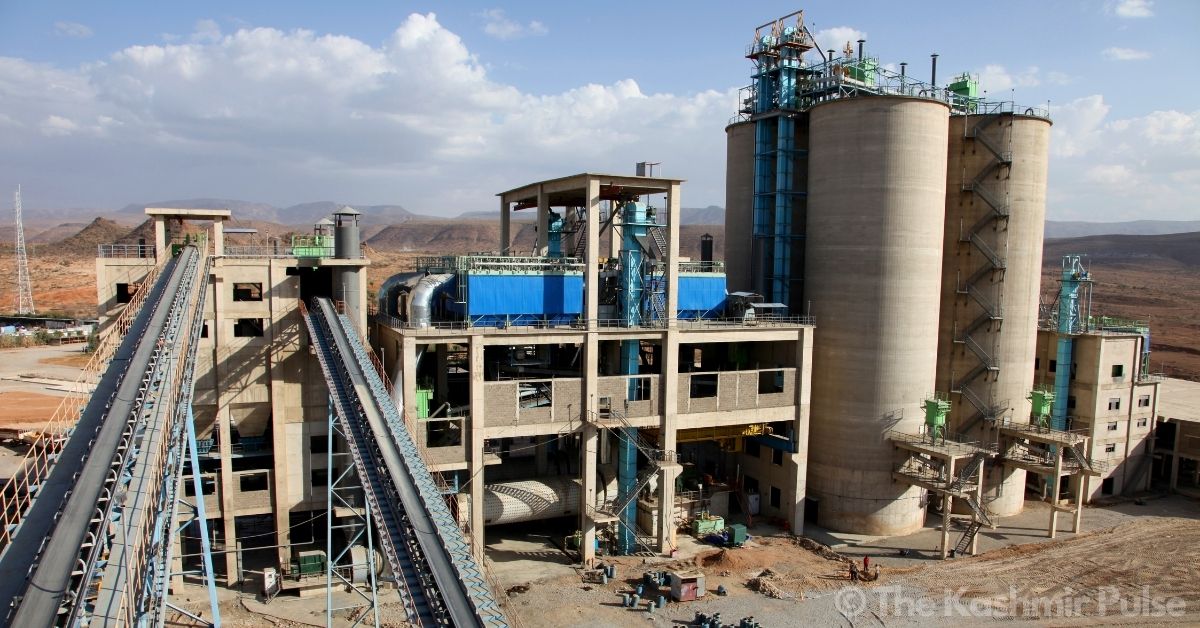
SRINAGAR — After exploring all possibilities for the revival of the Jammu and Kashmir Cements Limited, the Administrative Council (AC) which met here under the chairmanship of the Lieutenant Governor, Manoj Sinha, approved the proposal for disinvestment of Jammu and Kashmir Cements Limited (JKCL).

Rajeev Rai Bhatnagar, Advisor to the Lieutenant Governor and Dr Arun Kumar Mehta, Chief Secretary, J&K attended the meeting.

The disinvestment in JK Cements was necessitated as the company was not able to sustain and manage its finances properly and maintain efficiencies of operations over the period of time. The company was also not able to fully exploit the potential and sustain stiff competition in the market despite having dedicated limestone mining leases at its disposal.

In spite of enjoying an economy of scale, the company failed to show requisite growth and generate cash flows and operating margins during the last more than two decades.

The company, despite having assured demand from the government against advance payments, has not grown even marginally over the long period of time and has rather shown a sharp decline in its production and revenues from 2012-13 onwards. Managerial and financial inefficiencies, coupled with failure to exploit locational advantage, have made the company defunct, further depreciating plant and machinery without any resultant productivity.

The company had not only accumulated losses but is also burdened with liabilities on account of salaries and outstanding wages and payments in addition to default in statutory deductions like CP fund, GST etc.

Earlier also, the Administrative Council vide its Decision No. 113/15/2021; dated 19-10-2021 had given in-principle approval for the complete sale of JK Cements Limited by exploring the option of ascending e-auction and authorization to utilize 240 kanals of land adjacent to Khrew plant at Industrial Estate.

The interested bidder should have a minimum net worth of Rs 250 crore. The interested bidder should have a net positive EBITDA in at least three out of the immediately preceding last five financial years. Eligible entities are permitted to form a consortium to participate in the transaction. The maximum number of members, including the lead member, in a consortium, can be four.

Key principles and actions underlying the recommended disinvestment modality include 100% ownership in JKCL in favour of a private company/consortium. Further, all the assets of JKCL on an as-is-where-is basis, along with approvals and licenses (including mining license) will be transferred as part of the share purchase sale.

It was further decided that the Government of J&K will take over all employees of JKCL and the acquirer will be responsible for staffing requirements to get the plant operational. Moreover, all legacy and material liabilities will be carved out and assigned to the Union territory.

All the pre-bid requirements including renewal of the lease in favour of the corporation, power availability, finalization of accounts and their audits etc. shall be completed before the start of the auction process. While disinvesting, it shall be ensured that the provisions of the Mines and Minerals (Development and Regulation) Act, 1957and the rules framed there under are not violated in any case. It was also decided that the process of reverse auction will be adopted for the purpose of disinvestment.

This post first appeared on The Kashmir Pulse

SRINAGAR — After facing losses due to the halting of trucks on NH44, apple growers in Kashmir are now suffering due to freight rise, transport shortage and low demand for the fruit.

Growers from several areas told the news agency KNO that the demand for the fruit has remained low this year so far but freight has doubled and there is a shortage of trucks to carry apples outside Kashmir.

Shabir Ahmad, a grower from Shopian, said that they spend their savings on orchards but the returns are not satisfactory this year. He cites the increasing cost of labour, fertilizer and pesticide.

He said that growers are not able to get the amount they spend on orchards, incurring losses. “Freight rates have doubled in the last few days and even growers who are ready to pay the amount are unable to get trucks,” he added.

President Kashmir Valley Fruit Growers cum Dealers Union (KVFGCDU), Bashir Ahmad, admitted that freight charges have doubled in the last few days.

Due to the glut of fruit in markets outside after trucks were allowed smooth passage, he said, the demand for the fruit has decreased. Also, the transport shortage is because trucks are outside Kashmir with apples. He added that an actual assessment of the losses is being done.

This post first appeared on The Kashmir Pulse
SRINAGAR — After winding up Jammu and Kashmir Cements Limited, Lieutenant Governor Manoj Sinha-led administration has decided either outsource or sell its cement plants and a final decision will be taken in a week’s time.

Sources told the news agency KINS that the administration has approved the proposal of the Industries and Commerce Department regarding the complete sale or outsourcing of Jammu and Kashmir Cements Limited through ascending e-auction from qualified bidders.

“A final order will be issued within a week’s time. There are many businessmen in and outside J&K who have shown willingness to purchase its plants. The government will invite tenders in this regard very soon,” a senior official said.

The employees of J&K Cements Limited have been adjusted in various government departments. “Government requires a lot of money to clear the pending arrears of employees. Some amount of money coming from its sale or through outsourcing will be used to clear employees pending arrears,” the official added.

The decision has been taken in view of a sharp decline in production and revenues from 2012-13 onwards, the official added.

Over the loss-making years, the company has been burdened by its own liabilities on account of salaries/bills raised by the contractors and various departments, the CP Fund of employees, and GST liabilities.

Sources said that over the years, its production had declined due to a lack of proper management, and had been struggling with corruption and scams. “The successive elected governments had blamed each other for the downfall in its production. But no government made any sincere efforts for its revival,” a retired senior official of JK Cements said.

“The private cement manufacturing units earn huge profits, while JKCL was suffering losses due to administrative failure, and corruption. The government had directed several times to departments to prefer using this cement rather than private companies, but there was rarely any implementation on the ground,” the official said.

Being a state-owned company, it had a pivotal role to produce cement of well-standard quality at reasonable rates. “Unlike other cement plants operating in Kashmir, it had lost its market value due to production of lower quality cement. There are several factors responsible for its decline in production. Scams, mismanagement and interference by politicians, bureaucrats, and industrialists are the main reasons,” the official said.

JKCL was incorporated as a fully owned government company in December 1974 with the objective to exploit the abundant deposits and make quality cement available to consumers at reasonable rates, besides filling up the gap between demand and supply.

The JKCL was providing employment to more than 1000 semi-skilled, skilled, specialised and super-specialized people directly or indirectly.

This post first appeared on The Kashmir Pulse

SRINAGAR — Despite being high in produce, Kashmir’s walnut is gasping for breath and survival as the intrusion of the Californian walnut breed in Indian cities has cast a shadow on the Valley’s indigenous walnut produce and brought down its price.

Another reason which has left the walnut growers of Kashmir worried is climate change, population expansion, and the imposition of GST and VAT.

Official figures available with the news agency KNO suggest that India produced 2.82 lakh tons of walnuts in 2021-22 with J&K accounting for around 92 per cent of the produce. Anantnag and Kupwara are the leading producers of walnuts in Kashmir.

The year wise-walnut production in Kashmir states 190,451 MTs in 2017-2018, 198,431 MT in 2018-2019, 180,973 MT in 2019-2020, 177,070 MT in 2020-2021 and 182,659 in 2021-2022.

Walnut cultivation continues to shrink steadily from 47,004 hectares in 2017-18, 46,118 hectares in 2018-2019, 46,175 hectares in 2019-2020, 46,134 hectares in 2020-2021 and 46,197 hectares in 2021-2022.

The absence of scientific intervention and many other factors hit Kashmir's walnut industry badly with growers looking for alternative crops like apple plantations to earn a livelihood.

Talking to KNO, Director Horticulture Ghulam Rasool Mir said that 13 nurseries of high-density walnut trees will be established this year in Kashmir. “There is a subsidy of 7.5 lakh per hectare for producing walnuts. We are also creating mass awareness to raise the export figure,” he said.

He added, “We are reaching out to walnut growers across the Valley and every step to restore the glory of Kashmiri walnuts is being taken.”

Akhtar Hussain Malik, a noted Botanist at Kashmir University told KNO that there are multiple reasons responsible for the declining demand and quality of Kashmiri walnuts.

“Intrusion of Californian walnuts in Indian cities and their less price has cast a shadow on Kashmir’s walnut produce. The price of walnuts from Kashmir has significantly dipped as Californian walnuts are sold in Indian markets,” Malik said and added that other reasons include climate change, population explosion and drought-like conditions.

President of Dry-fruit Growers Association Kashmir, Bahadur Khan said that imposition of Goods and Services Tax/VAT has taken a serious toll on walnut export in Kashmir.

“The Goods and Services Tax (GST) announced by the Union government also spelt problems for Kashmir’s walnut growers. In July 2017, walnuts were first put under the 12 per cent tax slab but later added 5 per cent bracket after a show of strong resentment by growers,” he said.

Khan said that there are three varieties of walnuts that grow in Kashmir. “These are locally called Wonth, Kagazi, and Burzul. The Wonth is a hard nut to crack. It is mostly sold locally and is used for its oil. The Kagzi is a larger-size walnut with a thin outer shell. The Burzul is a medium-size variety and all are top quality walnuts,” he said, adding that there is a need for a market intervention scheme to save the walnut industry from sinking.

This post first appeared on The Kashmir Pulse

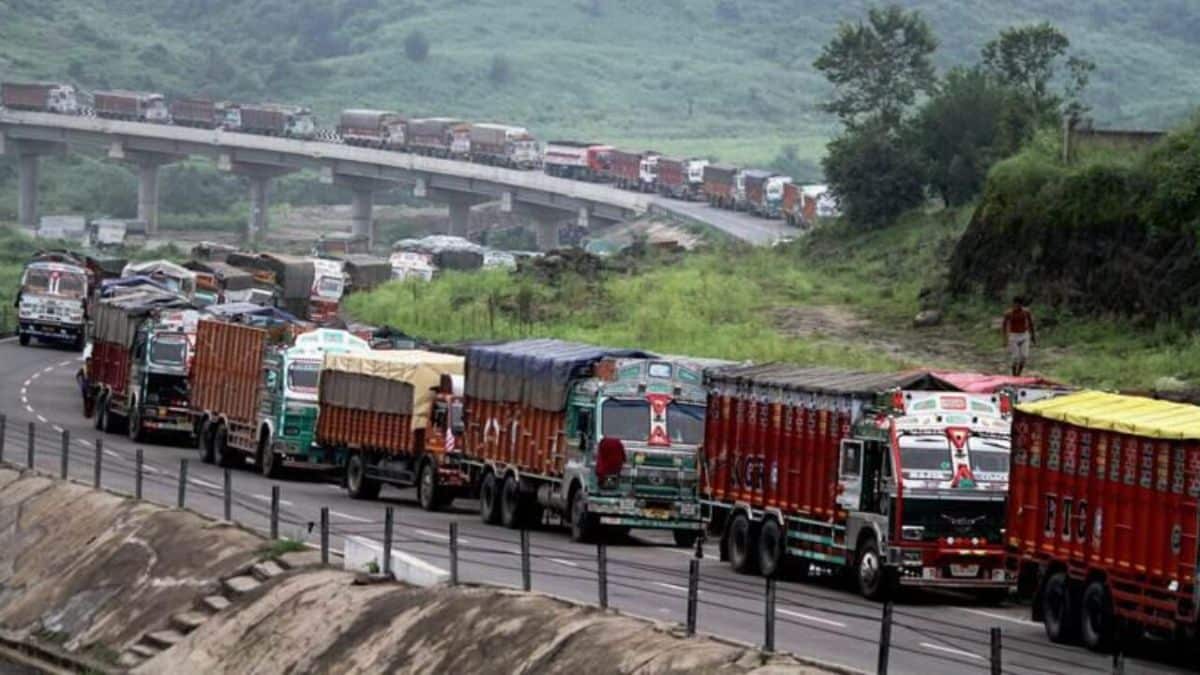
SRINAGAR — Divisional Commissioner Kashmir P K Pole on Monday said that all trucks stranded on the Srinagar-Jammu National Highway will be cleared by tonight and that there were natural reasons for halting trucks on the highway.

Talking to the news agency KNO, Pole said that all trucks including fruit-laden trucks will be cleared on the national highway by tonight. He added that trucks and other vehicles are only halted on the highway when there are shooting stones at some places along the highway and due to inclement weather.

“The allegations levelled by fruit growers’ associations that trucks are deliberately halted on the highway are half truth. By tonight, all trucks will be cleared on the highway,” he added.

Meanwhile, in a statement, a spokesperson said that all stranded Jammu-bound trucks will be cleared by tonight and around 4000 trucks were on their way. The statement reads that around 46,000 goods-laden trucks including 29000 apple trucks have been sent out of Kashmir since September 1.

“The claim made by certain fruit growers’ associations on the halting of fruit trucks is half-truth and natural reasons are hindering traffic. We have difficulties in the movement of traffic on the highway due to rains and resultant shooting stones which is beyond human control,” it added.

It further reads that normally apple production in Kashmir is 17 metric tons but due to abundant rainfall, there has been a bumper crop and will cross 21 metric tons.

“Truckers should use the alternate Mughal road to lessen the burden on Srinagar-Jammu National Highway, while the administration is making all efforts to maintain the flow. Drivers of empty vehicles are also appealed to use Mughal road,” it added.

This post first appeared on The Kashmir Pulse

SRINAGAR — As a mark of protest to press for smooth passage to fruit-laden trucks on the Srinagar-Jammu national highway, Fruit Mandis across Kashmir remained shut for the second consecutive day.

Several fruit growers and buyers told the news agency KNO that they continue to face losses due to unnecessarily blocking of the highway at Qazigund. "Despite government directions, authorities have failed to ensure the hassle-free movement of apple-laden trucks on the national highway," they alleged.

"Fruit-laden trucks are being halted at Qazigund for around a week after that they get a turn to move towards Jammu despite clear directives to ensure the hassle-free movement of fruit-laden trucks," Mudasir Ahmed, a fruit buyer said.

He said it seems that the authorities are in no mood to put an end to the miseries being faced by the fruit industry.

"It was earlier taking seven days to reach fruit trucks from Sopore Fruit Mandi to Bangladesh but now it's taking at least 12-15 days and the same is happening with others and upon reaching the destiny, the items we supply get spoiled and are of no use," said Fazzul Rehman, a foreigner who is dealing with fruit trade at Fruit Mandi Sopore for decades. He added that they are now on the verge to wind up the business as they are facing huge losses.

President, Kashmir Valley Fruit Growers-cum-Dealers Union (KVFGCDU), Bashir Ahmad told KNO that they were hopeful that the government will take their issue seriously.

He said they expect the government to implement the directions for smooth passage to trucks. “We want our produce to reach its destination outside the Valley in time,” he said.

Bashir said that Mughal road, which the government has kept as an alternative for the trucks, is not feasible as the condition of the road is not good.

Mandis to resume functioning from tomorrow: KVFGDU

Amid protests against the ‘unnecessary’ halt of fruit-laden trucks along the Srinagar-Jammu highway, the fruit growers on Monday met the Transport Secretary and Inspector General of Police (IGP) Traffic, seeking immediate redressal of their grievances.

The delegation of fruit growers under the banner of Kashmir Valley Fruit Growers-cum-Dealers Union (KVFGDU) met the officials today and apprised them about their sufferings and losses due to the halt of fruit-laden trucks along the highway.

The government has assured them that all the stranded fruit-laden trucks on the way to Jammu will be cleared tonight and more proactive steps will be taken to end the miseries of fruit growers and dealers.

President of KVFGDU, Bashir Ahmad told the news agency KNO that during the meeting with IGP Traffic and Transport Secretary, they were assured that all fruit-laden trucks halted in Qazigund will be cleared tonight and priority will be given to fruit-laden trucks.

He said that since Sunday, the movement of apple-laden trucks is continuously being allowed to move towards Jammu and they are hopeful that the government will prioritize the movement of apple-laden trucks.

He, on behalf of all fruit associations, thanked government officials who were part of the meeting, especially IGP Traffic for listening to their issues and assuring that additional steps will be taken to increase the flow of apple trucks.

Meanwhile, the top officials told KNO that since September 1, 45923 trucks (including 17631 apple trucks) have moved from Srinagar to Jammu via tunnel as per the details provided by NHAI. Trucks have been allowed to ply from Srinagar to Jammu on the last three consecutive days: September 24, 25 and 26.

On September 24, only 825 trucks (including 671 apple trucks) were allowed to ply after shooting stones started at Mehar and the traffic had to be suspended. On September 25, 4554 trucks (including 3995 apple trucks) were released, out of which 1500 trucks got stranded at Mehar on account of shooting stones and have passed down to Jammu today.

On September 26, trucks have again been released from Srinagar to Jammu and the backlog of all the approx 2500 trucks at Qazigund will get cleared today itself, as per the officials.

Further, apple trucks are given priority for release in traffic at Qazigund as shown by the large majority of apple trucks in the trucks released each day. “Hence in no case does any apple truck remain stranded at Qazigund for more than two days contrary to the false claims and propaganda that is being spread by vested interests. Traffic Police, J&K will initiate strict action against individuals who are spreading false and unverified information regarding the movement of apple trucks,” they added further.

Moreover, the Traffic Police has taken a number of additional steps to increase the flow of apple trucks, they said.

This post first appeared on The Kashmir Pulse
Powered by Blogger.