The catalogue "Dark Endeavour" written by Ishrat Ashraf Malik is precisely the packet of poems, summaries and extracts. In fact, the edition primarily converses about the tales having a new tone that indeed reflects the identity of the character who survives within different environments. The author actually articulates the various odds that a person faces during survival.

At birth, the author has emphasized the lines bountifully by capturing the theme of the mighty personalities of every creature, the issues and trends, the tranquillity of souls and the day-to-day sighs of society.

In the opening pages of the book, the author has immensely jotted down the role of mother and father. In Qur'an, we have been directed to be good to our parents (Al-Isra 23) and the author has tactfully tried to pen down the importance of being good to our parents. Agreeing with the author, both mother and father are gifts from Almighty Allah.

In this edition, the author addresses suicide and suicidal thoughts. Though suicide seems a little word but taking life in the addressed direction is not easy. Suicidal thoughts have their own effect beyond the imagination as it does not only affect us physically but mentally also. Let's spend our time with our family and friends, let's show some empathy, let's love each other unconditionally, let's devote ourselves to our Lord and let's find a solution together.

In the book if we talk about the features that the author has used, we need to notice that the use of words is soft, every reader can grasp the message of each and every write-up. The messages are showing honest reflections. The author has created an amalgam of themes in a single vase. Sometimes, the author has painted the write-ups with religious themes and somewhere the write-ups reflect the naturalist moods of the author. Like this, every page is having numerous advice, guidance and counselling for a good reader. Some glimpse is as under:

Combined families like delebrations,
If we can, all day like celebrations.
Live together like a family,
Left all pains and be frankly.
It was in past, not in present
Mow it's half and decent.

From the above mentioned stanzas of "Society", Miss Ishrat clearly mentioned that the status and fame are the biggest tools for standing for humanity, it doesn't matter how, who we people are, but being a voice to each other and standing behind every pain and problem is humanity.

The mission is the same for all but together it will be rated as a credential for deeds. Singularity can gain the worth of wealth but support, motivation, positivity and honesty will spread the knowledge of consciousness!

Similarly, in the poem "Youth", she tries to explain the role of youth for the prosperity and success of a nation.

Beautiful voices around us,
Not sure, but cheers up.
See the mountains, fill with ice peaks,
Found lonely and lessons teach.
Can silent prayers help us there,
Find peace of soul and go from here.

In this poem, Miss Ishrat addresses the beauty of "Kashmir" and the pain at the same time. The snow-clad summits take our breath. Kashmir seems a wonderful place but it hides treasures of agony. And all we feel is agony and agony all over again.

Kashmir displays a wonderful scene, behind the scene is quite a troublesome pain, suffering and tribulations. This book definitely helps you to come out from the trauma, as she writes:

Life is a trust,
Don't waste it on drugs
Your existence is so precious.
And let fulfil your life with fruitful.

From the aforementioned quotation, Miss Ishrat attempts to explain that time is very precious. She advises us that we must take advantage of time and never use it in an inappropriate way to repent later.

In this book, the writings not only reflect her way of thinking in a simple and creative way but also motivate teens to love themselves. She tries to explain that life is a journey packed with love and inspiration. In life, there's no requirement of weeds, too good to begin with, and life has the potential to lead us further than drugs, so get the drugs out before it blows us out of life.

The more we utilize, the less we survive. We have no time to deal with drugs, we have no time for narcotics and we don’t have time for meds because our lives are important and our life matters.

The book "Dark Endeavour" has an interesting fact that can help an individual to overcome depression, anxiety and various unordered matters. It's important to mention here that the poet has not left any stone unturned to put all efforts to display a picture framed with various suggestions that may be helpful in every aspect of life.

I will give it 3-star rating to the book and it seems to be necessary to go through this book in order to make life's environment favourable.


Book: Dark Endeavour

Genre: Open

Author: Ishrat Ashraf Malik

Publisher: Serving Publication

Year of Publication: 2022

ISBN: 979-8806236648

Pages: 50

Price: ₹250 / $3.22 (Approx.)
This post first appeared on The Kashmir Pulse

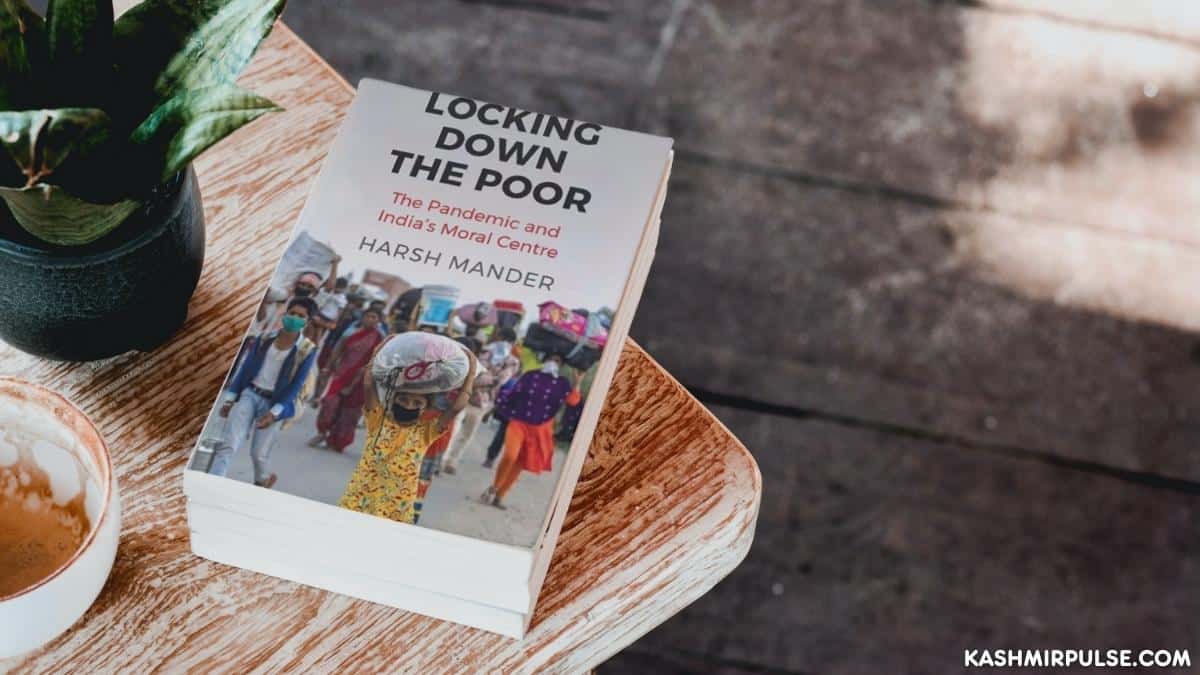
Locking Down The Poor is merely evidence of the biggest humanitarian crisis after partition by their own government which failed to tackle the situation and plunged a population of 1.3 billion into nationwide lockdown within less than four hours of notice.

Harsh Mander is one of India’s most trusted and courageous social justice and human rights activists. He also has served as Special Commissioner to the Supreme Court of India in the Right of Food campaign. Mander is also the author of several acclaimed books on contemporary India including Looking Away: Inequality, Prejudice and Indifference in New India; Partitions of the Heart: Unmaking the Idea of India etc.

On the night of March 24, 2020, the country’s Prime Minister announced a nationwide lockdown due to COVID-19, giving the population of over 1.3 billion less than four hours notice and imposing the world’s longest and most stringent lockdown with no or smallest relief packages and pushed them to the brink of starvation.

Locking Down The Poor: A result of Mander’s groundwork with “Karvan-e-Mohabbat”

Mander’s groundwork with “Karvan-e-Mohabbat” helped him to write tragic incidents which he witnessed himself while working with a vulnerable group of people during and after lockdown.

Mander in his book brings us accounts of out-of-work daily wagers and informal workers, the homeless and the destitute, all overwhelmed by hunger, helplessness, humiliation and dread: from the highways and the overcrowded quarantine centres and stories of migrant workers who walked hundreds of kilometres to reach their homes.

Mander's Locking Down The Poor - The Pandemic and India’s Moral Centre is written in lucid language so one can understand easily the callousness of the government policies. The book includes 12 chapters that all depict the ground realities in a well-articulated and organized manner.

Mander combines the hard data and life stories he went through during his excellent work on the ground as a social worker of his NGO "Karvan-e-Mohabbat" who facilitated lakhs of people with mid-day meals and other facilities when the government couldn’t provide relief to the poor people and the destitute ones. It’s merely a joke to maintain social distancing where people live in slums, shanties and where families of five to six members live in one room and do not have separate washrooms as well.

He writes, “A young woman with listlessness baby at her hip speaks into the camera held by my young colleagues who are interviewing people affected by the lockdown. She addresses Prime Minister Modi and Chief Minister Kejriwal. 'Is this the state you want to reduce us to?' she asks them piercingly. Another woman says, 'We fear we are fated to die. They say this Corona illness will go on for a year. They will later say we died of Corona, but actually would have died of hunger.'"

"Residents of both settlements tell us that as summer is peaking, drinking water is becoming as scarce as food. There has never been a water supply of any kind in either settlement or public tap. In Majnu ka Tila, they usually carry water in plastic containers from outside an apartment building a kilometre away, and in Tughlakabad, they beg the driver of the tanker that comes to water the trees lining the main avenue for some water. This has become near impossible now; the police chase them back, often thrashing them with their lathis for violating 'Modi ji's curfew'. Bathing even occasionally has become a challenge, and washing hands frequently, of course, was out of the question even before the lockdown."

While reading the book, tears flow from my eyes, and heartwrenching incidents are mentioned in the book. To wash your hands properly, you need at least two litres of water. Where there is a scarcity of water to drink, how could you wash your hands with water? People couldn’t afford soap, how they could buy handwash and sanitisers?

The Muslim community also was targeted by the government as they allegedly spread the infections of Corona in India. Mander writes, “The flames of hate against Muslims lit by the tenor of official briefings, amplified by hysterical media reports and biased television debates, then engulfed the entire country, their spread aided by the loyal trolls of social media including members of the infamous BJP IT Cell."

"A flood of fake videos was unleashed on the internet, depicting Muslims deliberately smearing vegetables and fruits with their saliva, spitting into the food served in restaurants and coughing into the faces of other people, all with the intent of infecting non-Muslims. 166 Hashtags like #CoronaJihad, #BioJihad and #TablighiJamaatVirus began to circulate and trend."

"Two researchers, Soundarya Iyer of the French Institute of Pondicherry and Shoibal Chakravarty of the Divecha Centre for Climate Change at the Indian Institute of Science found 11,074 stories published from 271 media sources with the term "Tablighi Jamaat' from March 20, 2020, to April 20, 2020. Their analysis noted that the words that frequently appeared alongside 'Tablighi' and 'Jamaat' were 'Coronavirus', 'Delhi', 'lockdown', 'violating', 'crime', 'spitting', 'terrorist' and 'jihad'. Even a leading newspaper like the Times of India, the country's largest-selling English daily, carried as many as 1863 stories of the Tablighi Jamaat in these five weeks, which were shared 3,19, 921 times on Facebook."

"These stories fed into an epidemic of Islamophobic fake news and hate speech," they wrote in The Hindu BusinessLine. This was 'exploited for the production of misinformation and hate'.

This book is a critique of the callousness approach of the government and its unequal approach to society. Locking Down The Poor is a poignant book written in lucid language, which is absolutely a good read.

The flap of the book is well-designed and somewhat unique. The book looks good but the paper quality could have been better at the price this book is selling for.


Book: Locking Down The Poor

Genre: Non-fiction/Current Affairs

Author: Harsh Mander

Publisher: Speaking Tiger Books

Year of Publication: 2021

ISBN: 978-9389958751

Pages: 240

Price: ₹399 / $5.30 (Approx.)

This post first appeared on The Kashmir Pulse
Powered by Blogger.